

⚙️ MERCEDES 7G-DCT AUTOMATIC TRANSMISSION: JERKING, SLIPPING, FAILURES, AND DEFINITIVE SOLUTIONS (2026 GUIDE)
Updated 2026 · Technical analysis for Mercedes A-Class W176 (A180, A200, A250), CLA, GLA, B-Class
Quick Answer
The Mercedes 7G-DCT transmission (code 724.0/724.1) is a dual-clutch automatic transmission fitted to A-Class W176, CLA C117, GLA X156, and B-Class W246 models from 2013 to 2020. The most frequent causes of jerking and slipping are clutch wear (€900-€2,000 replacement), defective mechatronics (€1,200-€3,000), and degraded oil (€200-€350 change). On A180d/A200d diesels, clutches wear out between 70,000-100,000 km. MB 236.21 specific transmission fluid is mandatory every 60,000 km. Typical DTC codes: P1872, P1890, P17XX.
Read also: MERCEDES A-CLASS W176 PROBLEMS (2012–2018): COMMON FAULTS, SYMPTOMS AND SOLUTIONS
📋 Article Index
- 🔧 What is the Mercedes 7G-DCT transmission?
- 🚘 Which Mercedes models use the 7G-DCT?
- 🔍 What are the typical symptoms of a struggling 7G-DCT?
- 🧩 What are the most frequent causes of faults?
- 🧰 What interventions really solve the problems?
- 🛠️ How is proper maintenance of the 7G-DCT done?
- ⏳ How long can the 7G-DCT really last?
- 💰 How much do interventions cost in 2026?
- 🛡️ How to prevent 7G-DCT problems?
- 🔗 Related insights
- ❓ Frequently Asked Questions
- 📌 Conclusions
🔧 WHAT IS THE MERCEDES 7G-DCT TRANSMISSION?
The Mercedes 7G-DCT (code 724.0 / 724.1) is a 7-speed dual-clutch automatic transmission designed to offer quick shifts, low fuel consumption, and an enjoyable driving experience both in the city and on more dynamic routes. It is one of the most common components on Mercedes compacts produced between 2013 and 2020, particularly on the A-Class W176 and models sharing the MFA platform (CLA, GLA, B-Class).
Technically, the 7G-DCT combines two wet multi-plate clutches (one for even gears and one for odd gears), a mechatronics unit that manages pressures and engagements, and a lubrication system highly sensitive to oil quality (specification MB 236.21). When everything works correctly, the transmission operates smoothly and precisely; however, unlike torque converter transmissions, the DCT requires rigorous maintenance and reacts poorly to degraded oil or outdated software.
Over the years, common problems have emerged—jerking, slipping, vibrations, irregular engagements, and mechatronics failures—which often appear as early as 70,000 to 120,000 km, especially with intense urban driving or neglected maintenance. For this reason, the 7G-DCT is considered one of the "components to monitor" on Mercedes W176 series vehicles.
In this 2026 guide, we clearly and practically analyze:
- 🔍 the real symptoms to recognize a transmission problem
- 🧩 the most frequent causes (clutches, mechatronics, oil, software)
- 🛠️ the recommended interventions for a definitive solution
- 💰 the real costs in 2026 based on qualified workshops
- 🛡️ the best prevention practices to avoid costly failures
This guide is based on practical experience, real diagnoses performed in workshops, documented cases, and feedback from technicians who work daily on this transmission.
🚘 WHICH MERCEDES MODELS USE THE 7G-DCT?
The Mercedes 7G-DCT automatic transmission (code 724.0 / 724.1) was installed on numerous compact models from the manufacturer between 2013 and 2020. It is particularly common in vehicles based on the MFA modular platform, designed for transverse engines and front-wheel drive/4MATIC.
🔥 1) Mercedes A-Class W176 (2013–2018)
- A180 (petrol and diesel)
- A200
- A220 / A220 4MATIC
- A250 / A250 Sport
This is the model with the most reported issues: intense city use, high mileage, and not always respected maintenance make the 7G-DCT particularly sensitive, especially on A180 and A200 diesels.
🔥 2) Mercedes CLA C117 / Shooting Brake X117
- CLA 180 / 200 / 220
- CLA 250
- CLA 45 AMG (pre-facelift versions do not always use the DCT)
On CLAs, the transmission often operates under more strenuous conditions (heavier body, high motorway mileage). Slightly premature clutch wear is observed, especially on diesel versions.
🔥 3) Mercedes GLA X156 (2014–2020)
- GLA 180 / 200 / 220 CDI
- GLA 250 / 250 4MATIC
The GLA, being a heavier crossover than the A-Class, stresses the clutches during uphill starts, light off-road use, and urban traffic. Jerking and vibration problems are frequent on vehicles with over 90,000 km.
🔥 4) Mercedes B-Class W246 (2013–2019)
- B180 / B200 petrol
- B180 / B200 CDI
The higher weight and higher center of gravity put more strain on the 7G-DCT, especially on mixed routes or when driving fully loaded. Here too, transmission oil maintenance is crucial.
📌 Petrol vs. Diesel versions: which suffer more?
The 7G-DCT transmission equips both petrol and diesel engines, but the stresses it undergoes vary greatly. Differences in torque, driving style, vibrations, and ECU strategies make some versions more prone to the classic problems of jerking, slipping, and clutch wear.
⛽ Petrol Versions: smoother operation and slower wear
The petrol engines in the A-Class, CLA, GLA, and B-Class range are generally "gentler" on the 7G-DCT. Technical reasons:
- Lower torque at low revs → less stress on the clutch pack during starting
- More linear power delivery → the transmission has to compensate for fewer torsional vibrations
- More stable transmission temperatures → lower risk of oil and mechatronics overheating
- Softer software strategies for low-speed shifts
In general, problems on A180, A200, and A250 petrol models tend to appear beyond 120-140,000 km or when the oil is never changed.
🚗 Diesel Versions: more torque = more stress on clutches and mechatronics
Diesel engines are significantly more demanding on the 7G-DCT, especially during starting phases and transitions between 1st–2nd–3rd gear. This happens because:
- Diesels generate a lot of torque as early as 1,500 rpm, overloading the multi-plate clutches
- Higher torque produces more frequent micro-slips, accelerating wear
- The typical torsional vibration of diesels can damage mechatronics actuators and sensors
- Many diesels are used almost exclusively in the city → increased engagements and frequent starts
For these reasons, on diesel versions, problems can arise as early as between 70,000 and 110,000 km, especially if the oil change is not performed every 60,000 km.
🚨 The most problematic versions (workshop statistics)
Based on data collected from hundreds of interventions at specialized workshops, the versions that most often present 7G-DCT problems are:
- Mercedes A180d W176 → urban use, frequent starts, more undersized clutches
- A200d / A220d → high torque = accelerated clutch pack wear
- CLA 200d / CLA 220d → heavier body + transmission stressed during acceleration
- GLA 200d → higher weight, uphill use, light off-road combinations
- B180d / B200d → high center of gravity and greater overall mass
A factor almost always present in problematic vehicles is neglected maintenance: over 70% of faulty transmissions had never received an oil change in the previous 100,000 km.
⛔ Excluded: models with 7G-TRONIC transmission
It is important to clearly distinguish the 7G-DCT fitted to compacts (A-Class, CLA, GLA, B-Class) from the 7G-TRONIC, the renowned Mercedes automatic transmission with a torque converter. Although the name is similar, these are two completely different transmissions in terms of structure, operation, maintenance, and types of problems.
🔍 Why should they NOT be confused?
The 7G-DCT is a dual-clutch transmission, designed for compact cars and transverse engines, with quick shifts and behavior very similar to an automated manual transmission. The 7G-TRONIC, on the other hand, is a classic automatic transmission with a hydraulic torque converter, much more robust and used on heavier and more powerful cars (C-Class, E-Class, GLC, GLE, S-Class, and rear-wheel drive models).
⚙️ Main technical differences
| Characteristic | 7G-DCT | 7G-TRONIC |
|---|---|---|
| Transmission type | Dual-clutch (DCT) | Torque converter |
| Vehicles | Mercedes Compacts (A/CLA/GLA/B) | Large models (C/E/GLC/S…) |
| Specific oil | MB 236.21 (DCT fluid) | MB 236.14 / 236.15 (ATF) |
| Mechanical robustness | Medium-high, sensitive to clutch wear | Very high, reliable even beyond 250,000 km |
| Oil maintenance | Oil change every 60,000 km | ATF oil change every 50–70,000 km |
| Typical problems | Jerking, mechatronics, clutches | Pressure valve, converter (rare) |
Important: using MB 236.14/236.15 oil instead of MB 236.21 can cause severe damage to the 7G-DCT mechatronics. These are completely different products despite the similar name.
🔍 WHAT ARE THE TYPICAL SYMPTOMS OF A STRUGGLING 7G-DCT?
When the 7G-DCT transmission begins to wear out or shows mechatronics anomalies, the signals come gradually and are often underestimated. Recognizing them early can prevent more serious damage and very costly repairs.
⚠️ Main and most obvious symptoms
- Jerking on starting — especially when hot or after long traffic jams. This often indicates clutch wear or incorrect hydraulic pressure in the mechatronics.
- Gear slipping — typical between 2nd-3rd or 3rd-4th. The engine revs up but the car does not accelerate proportionally → critical sign of clutches at their limit.
- Vibrations between 20 and 40 km/h — a delicate phase for the DCT where dual even/odd gear management occurs. If it vibrates, it's often a sign of a difference in engagement between the two clutches.
- Harsh or irregular engagements at low speeds — annoying "shocks" when releasing the brake, parking, or maneuvering. These can indicate mechatronics actuator levers out of tolerance or incorrect clutch calibration.
- Delay in accelerator response — a classic symptom of insufficient oil pressure or outdated software.
-
Warning light or transmission fault message — the instrument cluster often displays messages such as:
"Transmission fault. Visit workshop."This can be caused by errors in clutches, pressure, sensors, or mechatronic actuators.
🔎 Secondary symptoms (but equally important)
- Difficulty uphill or when overtaking — the transmission struggles to select the right gear → common symptom of progressive slipping.
- Engine "screams" but propulsion is poor — typical case of worn clutches or out-of-spec calibration.
- Intermittent metallic noises from the transmission — possible symptom of fatigued gears or actuators. Must be checked immediately.
- Slight jolts in Eco/Comfort mode — often indicate the need for a software update or clutch re-learning.
- Burnt oil smell in heavy traffic — the DCT suffers from heat: can be an early sign of clutch overheating.
🚨 When is the transmission truly at risk?
If you notice at least 2 or more symptoms simultaneously, workshop experience indicates the probable presence of:
- Clutches over 80% worn
- Mechatronics not maintaining pressure
- Oil degraded beyond thermal limits
- Severe slipping detected by the TCU control unit
Early intervention avoids costly breakdowns and often allows for a simple oil change + software update, instead of a complete clutch pack replacement.
🧩 WHAT ARE THE MOST FREQUENT CAUSES OF FAULTS?
The 7G-DCT transmission is a sophisticated but complex system: it combines two clutches, high-precision mechatronics, multiple sensors, and a hydraulic circuit extremely sensitive to oil quality. When one of these elements deteriorates or deviates from correct parameters, the classic symptoms appear: jerking, slipping, vibrations, and failures.
1️⃣ Clutch pack wear (the most common cause)
The 7G-DCT clutch pack consists of two wet multi-plate sets: one for even gears, one for odd. These elements are subject to regular wear, and on Mercedes compacts—especially diesels—they wear out faster than expected.
🔧 Why do they wear out so quickly?
- Intense urban driving: continuous stop-and-go → progressive overheating
- High torque of diesel engines → strong stress on the clutch discs
- Degraded oil → reduces cooling capacity and shifting precision
- Out-of-parameter clutch calibration → increased micro-slipping
📉 Most typical symptoms
- Jerking during maneuvering or starting
- Obvious slipping between 2nd-3rd / 3rd-4th
- Vibrations below 40 km/h
- Engine revs increase without actual acceleration
2️⃣ Defective mechatronics (the most expensive fault)
The mechatronics is the "brain" and "hydraulic heart" of the 7G-DCT: it manages pressures, engagements, actuators, solenoids, and clutch coordination. It is also one of the most delicate components.
💥 Common mechatronics defects
- Solenoids that do not modulate correctly → jerking or gears not engaging
- Pressure loss → slipping and shifting into protection mode
- Internal sensors out of tolerance → unpredictable gear engagement
- Electronic failures → recurring errors and transmission lock-up
- Loose contacts on mechatronic connectors → intermittent errors that worsen with humidity or vibrations
📟 Most common error codes
- P17XX (various) → pressure / engagement / clutch problems
- P1890 → clutch regulation out of parameter
- P1872 → actuator error
- P0700 → MIL request from the transmission control unit (generic code)
- P0741 → torque converter clutch performance/stuck off
- P0746 → pressure control solenoid
For intermittent mechatronic errors, especially on vehicles over 100,000 km exposed to humidity or road salt, a common cause is oxidized contacts on the mechatronic and sensor connectors. Before replacing the mechatronic unit, thorough cleaning with a specific non-conductive cleaner can solve the problem:

WD-40 SPECIALIST 39368 – ELECTRICAL CONTACT CLEANER 400 ML
Fast-drying, non-conductive contact cleaner spray, NSF K2 certified. Removes oxidation, dirt, and residue from mechatronic connectors, transmission sensors, and wiring. Safe on plastics and rubber. Useful as a first diagnosis for intermittent 7G-DCT errors.
🛒 Buy now on Autoricambi Tritella3️⃣ Degraded or never replaced transmission oil
Although some versions of Mercedes manuals mention "no oil change needed," in practice, workshops and specialized technicians confirm the opposite: the 7G-DCT oil must be replaced every 60,000 km, with specific MB 236.21 oil.
🛢️ Why is it so important?
- The DCT generates a lot of heat → oil quickly loses viscosity
- Degraded oil = unstable hydraulic pressure
- Increased friction on clutches → accelerated wear
- Mechatronic unit suffers from dirt, residue, and deposits → premature failure
📌 Signs of exhausted oil
- Slow or irregular shifts
- Increased transmission temperature
- Progressive slipping
- Vibrations during acceleration
4️⃣ Outdated transmission software
Mercedes has released numerous updates over time that significantly improve the behavior of the 7G-DCT, especially in urban driving and low-speed maneuvers.
📲 What do updates improve?
- More progressive clutch management → less jerking
- Optimization of hydraulic pressures
- Improved smoothness in shifts in Eco/Comfort mode
- Reduction of micro-slipping between low gears
- Reduction of vibrations between 20-40 km/h
🛑 Why is it important?
Outdated software can maintain old clutch parameters, causing premature wear and overheating. Many transmissions significantly improve after TCU updates + adaptation reset, without the need for mechanical interventions.
🧰 WHAT INTERVENTIONS REALLY SOLVE THE PROBLEMS?
Once the symptoms are identified, it is crucial to intervene correctly and promptly on the Mercedes 7G-DCT transmission. This transmission requires specific procedures and adequate equipment: improvising or relying on non-specialized workshops can cause irreversible damage.
✔️ 1) Complete professional diagnosis (mandatory phase)
Diagnosis on a 7G-DCT is not limited to error reading. It requires advanced analysis with official or equivalent testers (Xentry, Autel, Launch, Topdon Phoenix, Bosch KTS).
🔍 The diagnosis must include:
- Reading TCU (Transmission Control Unit) error codes
- Clutch parameters: slip, estimated residual thickness, engagement points
- Real-time hydraulic pressures (fundamental for evaluating the mechatronic unit)
- Oil temperatures and overheating history
- Actuator tests (solenoids, shift levers)
- Current adaptations and clutch learning status
✔️ 2) 7G-DCT oil change (every 60,000 km)
The oil change is the most effective and preventive intervention to preserve the 7G-DCT. Although some versions of the manual indicate it as "unnecessary," in practice:
- Oil degrades quickly due to the high heat generated by the DCT
- Exhausted oil causes slipping and unstable pressures
- Dirty oil damages the mechatronic unit and solenoids
The replacement must be done with specific MB 236.21 oil and with the correct filling procedure and level check at operating temperature.

VALVOLINE 908726 DCT – AUTOMATIC TRANSMISSION FLUID FOR 7G-DCT
Synthetic Valvoline DCT oil (formerly 866909) specific for wet dual-clutch transmissions. Compatible with MB 236.21 specification for Mercedes 7G-DCT (A-Class W176, CLA, GLA, B-Class). Maintains stable hydraulic pressure, protects clutches and mechatronic unit, reduces jerking and slipping. Recommended replacement every 60,000 km.
🛒 Buy now on Autoricambi Tritella✔️ 3) Clutch reset / adaptation (relearning)
After an oil change or in the presence of minor irregularities, an adaptation reset can significantly improve smoothness.
🛠️ What is it for?
- Recalibrates the clutch engagement points
- Reduces slipping and jerking
- Optimizes hydraulic pressure
- Restores original transmission behavior
This procedure should only be performed if the transmission and oil are in correct mechanical condition. If the clutches are too worn, the reset will not solve the problem and may worsen the symptoms.
✔️ 4) TCU software update
Mercedes has released numerous transmission software updates over time to correct known defects:
- Jerking at low speeds
- Vibrations below 40 km/h
- Suboptimal engagement logic
- Incorrect hydraulic pressures
After the update, it is recommended to perform an adaptation reset.
✔️ 5) Clutch pack replacement
When the friction material is worn, slipping becomes chronic and no electronic procedure can solve it. Replacing the clutch pack is a definitive solution.
🧱 Signs indicating clutches need replacement:
- Obvious slipping during acceleration
- Continuous jerking when hot
- Irregular engagements even after adaptations
- Error codes related to "clutch out of tolerance"
The cost varies greatly depending on the engine, but generally starts from €900-€1,400 with quality aftermarket parts, up to over €2,000 with original clutches.
✔️ 6) Mechatronic unit overhaul or replacement
When the mechatronic unit does not maintain pressure or has electronic malfunctions, the transmission often enters protection mode with messages such as:
🔧 Possible interventions on the mechatronic unit:
- Professional overhaul (solenoids, gaskets, sensors, actuators)
- Complete replacement with a new or reconditioned unit
- TCU software reprogramming + adaptation reset
Costs are higher: from €1,200 for a quality overhaul up to €2,400-€3,000 for a new mechatronic unit.
🛠️ HOW TO PERFORM CORRECT 7G-DCT MAINTENANCE?
The Mercedes 7G-DCT transmission requires regular and rigorous maintenance. It is not a "maintenance-free" transmission: on the contrary, its reliability depends heavily on the quality of the oil, the cleanliness of the circuit, and correct electronic calibration.
🛢️ 1) 7G-DCT oil change — every 60,000 km
DCT oil performs three vital functions:
- Cools the clutch pack
- Lubricates the gears
- Creates hydraulic pressure to operate the mechatronic unit
Over time, it loses viscosity, overheats, and becomes contaminated with metallic particles → shifting worsens, slipping increases, and internal pressure drops. The oil must meet MB 236.21 specification: using different products can seriously damage the mechatronic unit.
🧽 2) Filter/mechatronic screen filter replacement — every 60,000-80,000 km
The 7G-DCT integrates a dense filter screen that retains:
- Metallic residues
- Friction particles from the clutches
- Micro-carbon traces from overheated oil
When the filter clogs:
- Hydraulic pressure drops
- Actuators respond slowly
- Shifting becomes harsh or uncertain
- The "Transmission fault" light illuminates
Replacing the filter is an economical intervention that significantly extends the life of the transmission and mechatronic unit. On many models, the filter is integrated into a complete kit that also includes gaskets and bolts.
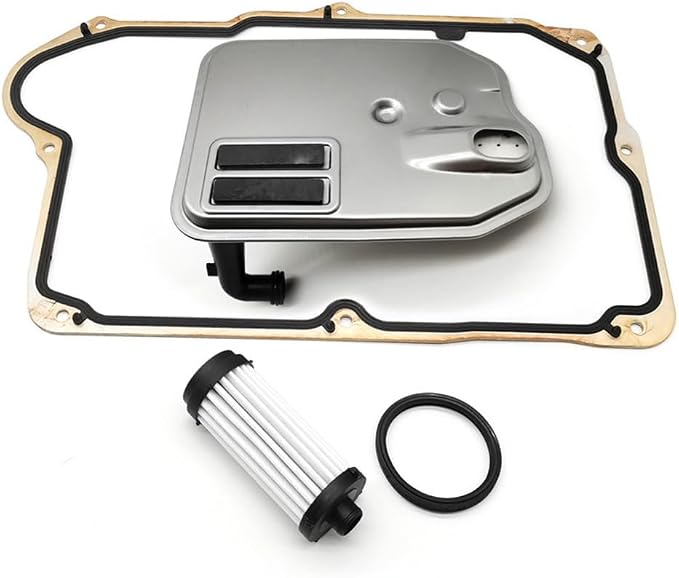
TRANSMISSION FILTER KIT 7G-DCT 724.0 / K7A240 / K7X400 (COMPLETE SET)
Complete kit for wet dual-clutch transmission filter for Mercedes 724.0 / 7G-DCT transmission. Compatible with A-Class W176 (A180, A200), B-Class W246 (B180, B200), CLA C117, and GLA X156. Includes main filter and service components. To be replaced every 60,000-80,000 km along with the transmission oil.
🛒 Buy now on Amazon*Amazon affiliate link: we may receive a small commission, at no additional cost to you. Always check compatibility with your car's manual before purchasing.
⚙️ 3) Clutch reset and adaptation — after every intervention
The 7G-DCT requires precise calibration to set:
- Clutch engagement points
- Contact pressures
- Engagement times
- Wear compensation
After each intervention (oil change, clutch replacement, software update), the adaptation reset + clutch relearning procedure must be performed.
📲 4) TCU software update — every 1-2 years
Mercedes periodically releases updates that:
- Reduce jerking at low speeds
- Optimize hydraulic pressure
- Improve clutch progression
- Reduce slipping and vibrations
- Increase mechatronic unit lifespan
Outdated software can cause aggressive shift logic that accelerates wear.
🚗 5) Driving behaviors that preserve the transmission
The 7G-DCT is very sensitive to driving style. Some habits help prevent wear:
- Avoid aggressive starts, especially when cold
- Do not hold the car on a hill with the accelerator: use the brake
- Avoid long traffic jams with micro-advances: alternate between brake/neutral when possible
- Do not accelerate hard at low speeds (1st-2nd gear): it puts enormous stress on the clutches
- Drive in Comfort mode during maneuvers and in the city
🧩 In summary: the ideal maintenance plan
| Intervention | Recommended frequency | Notes |
|---|---|---|
| Transmission oil change | Every 60,000 km | Use MB 236.21 oil |
| Filter replacement | 60,000-80,000 km | Prevents pressure drops |
| Adaptation reset | After each intervention | Clutch relearning |
| TCU software update | Every 1-2 years | Reduces slipping and jerking |
⏳ HOW LONG CAN THE 7G-DCT REALLY LAST?
The lifespan of the Mercedes 7G-DCT transmission depends on three main factors:
- Maintenance (oil change, filter, updates)
- Driving style (especially in the city)
- Engine type (petrol vs. diesel)
With correct maintenance, this transmission can be reliable and long-lasting. Without maintenance, however, it can start to have problems even before 100,000 km.
🧱 1) 7G-DCT Clutch Lifespan
| Usage Condition | Estimated Lifespan | Notes |
|---|---|---|
| Intense urban use | 70,000-100,000 km | Frequent starts, rapid overheating |
| Mixed use (city + extra-urban) | 100,000-140,000 km | Most common condition among Mercedes customers |
| Highway / extra-urban use | 140,000-180,000 km | Clutches work much less |
🧠 2) Mechatronic Lifespan
- Average lifespan: 120,000-170,000 km
- Lifespan with excellent maintenance: 170,000-210,000 km
- Lifespan without oil change: even 70,000-110,000 km
🔩 3) Complete Gearbox Lifespan
- Average complete gearbox lifespan: 200,000-280,000 km
- Lifespan with meticulous maintenance: 300,000+ km
💰 HOW MUCH DO REPAIRS COST IN 2026?
Repair costs for the Mercedes 7G-DCT vary based on the type of intervention, engine, type of spare parts (original, aftermarket, remanufactured), and workshop labor. Below is a realistic estimate based on hundreds of documented interventions at specialized workshops.
| Intervention | Average Cost (2026) | Technical Notes |
|---|---|---|
| Specialized OBD diagnostic | €60-120 | TCU reading + clutch and pressure parameters |
| 7G-DCT oil change | €200-350 | Includes MB 236.21 oil + mesh filter; recommended every 60,000 km |
| TCU software update | €80-150 | Improves clutch logic and pressures; recommended every 1-2 years |
| Clutch adaptation reset | €50-120 | To be performed after oil change, clutches, or software update |
| Clutch pack replacement | €900-1,700 | Depends on engine (diesels are more expensive) and type of spare part |
| Original Mercedes clutch pack | €1,400-2,000 | More expensive original, but with better durability on diesels |
| Remanufactured mechatronic | €1,200-1,700 | Common and reliable solution from certified centers |
| New Mercedes mechatronic | €2,000-3,000 | Maximum reliability; recommended for recent or high-value cars |
| Complete gearbox overhaul | €2,500-4,000 | Only necessary in extreme cases (gear damage / zero pressure) |
*Indicative prices May 2026, VAT included, workshop labor included. Variable based on area, model, and spare parts supplier.
💬 Do you have a workshop quote for the 7G-DCT gearbox?
Send us the quote, and we'll tell you if the prices are in line with the 2026 market. We'll help you find the right spare parts for your Mercedes (MB 236.21 oil, filters, clutch packs, certified remanufactured mechatronics) at correct prices — often saving 20-30% compared to the dealership.
📩 Request a free quote🛡️ HOW TO PREVENT 7G-DCT PROBLEMS?
The 7G-DCT gearbox can last for many kilometers if treated correctly. Since it is very sensitive to temperature, driving style, and oil quality, adopting the right habits can prevent over 70% of clutch and mechatronic failures.
🧊 1) Avoid harsh cold starts
When the engine and gearbox are cold, the oil is thicker, and the clutches struggle to find the correct engagement point. Aggressive starting can cause:
- Micro-slippage
- Premature overheating
- Unnecessary stress on the mechatronic unit
🛢️ 2) Always change the oil at 60,000 km
An oil change is the single most effective prevention. Clean oil (MB 236.21 specification) maintains:
- Stable hydraulic pressure
- Cooler clutches
- Solenoids and actuators free from residues
⛰️ 3) Do not hold the car on a hill using only the accelerator
This is one of the most common mistakes: keeping the vehicle "under tension" using only the accelerator makes the clutches work as if they were constantly slipping. Always use the brake or parking brake.
🔄 4) Software updates at every service
TCU (transmission control unit) software updates include improvements to:
- Clutch pressure curves
- Vibrations between 20-40 km/h
- Low-speed shift logic
- Anti-slip strategies
Outdated software can wear clutches more quickly.
👂 5) Do not ignore vibrations or small jolts
The 7G-DCT does not "heal itself." A small symptom today can become:
- Chronic slippage
- Loss of hydraulic pressure
- Mechatronic in protection mode
- Much higher repair cost
🔗 RELATED INSIGHTS
The complete guide to the Mercedes A-Class W176 (2012-2018) CORE: all problems and costs
→ Read more
Specific guide to recurring DTC codes on Mercedes CLA (CLA C117 engine cluster)
→ Read more
All specific gearbox oils: MB 236.21 for DCT, ATF Pro 236.14/236.15, automatic transmission oils
→ Go to Tritella catalogue
❓ FREQUENTLY ASKED QUESTIONS
Is the 7G-DCT a reliable gearbox?
Yes, if maintained correctly. Most failures result from never changing the oil, a clogged mesh filter, outdated software, or very intense city driving. With proper maintenance (MB 236.21 oil change every 60,000 km, software updates every 1-2 years), it easily exceeds 200,000 km.
Is it normal to feel some jolts when cold?
It is normal to feel a very slight roughness in the first few meters. However: if the jolts increase when hot, clutch wear is likely; if vibrations appear between 20-40 km/h, hydraulic pressure should be checked; if it worsens with traffic, it's a sign of degraded oil. More than 2 symptoms together = mandatory OBD diagnosis.
Can I continue driving with the "Transmission Malfunction" message?
No. Driving with a transmission in protection mode can cause clutch pack failure, permanent damage to the mechatronic unit, and total loss of traction. Stop and get an immediate diagnosis — what costs €200 for diagnosis today can cost €3,000 for a new mechatronic unit tomorrow.
Can a simple oil change solve jolts?
Often yes, if the problem is in its early stages. An oil change (MB 236.21) + adaptation reset + TCU software update can restore transmission smoothness without mechanical intervention. Total cost €300-450. However, if there are strong slips, it is likely that the clutches are worn and mechanical intervention is needed.
What oil should I use for the Mercedes 7G-DCT gearbox?
The specific oil is one with MB 236.21 specification, a synthetic DCT fluid designed for wet dual-clutch transmissions. It is NOT compatible with MB 236.14 or MB 236.15 (which are ATFs for 7G-TRONIC torque converter transmissions). Using the wrong oil can cause severe damage to the mechatronic unit within a few kilometers.
How much does a 7G-DCT oil change cost in 2026?
A complete oil change costs €200-350 at a specialized workshop, including the specific MB 236.21 oil (approximately 5-6 liters required) and replacement of the mechatronic mesh filter. It is the most important maintenance intervention and should be performed every 60,000 km — skipping it increases the risk of mechatronic failure by 300%.
How many km does the 7G-DCT clutch pack last?
It depends greatly on the engine and use: on petrol engines (A180, A200, A250), clutches often exceed 130,000-150,000 km; on diesel engines (A180d, A200d, A220d), they last an average of 70,000-100,000 km due to higher torque. Intense urban use can reduce lifespan by 30-40%. Driving style + oil maintenance are the decisive factors.
How can I tell if my 7G-DCT is healthy?
Signs of a transmission in good condition: smooth shifts both cold and hot, no vibrations between 20-40 km/h, quick throttle response, normal oil temperatures, no P17XX errors in diagnosis. A professional OBD diagnosis at €60-120 gives a precise picture of the clutch and mechatronic status.
📌 CONCLUSIONS
The Mercedes 7G-DCT is a modern, fast, and pleasant transmission to use, capable of offering excellent performance both in the city and on extra-urban routes. However, like all dual-clutch transmissions, it requires constant attention, rigorous maintenance, and timely interventions at the first signs of anomaly.
The most common problems — jolts, vibrations, slips, or fault warnings — do not necessarily mean the end of the gearbox: they often result from degraded oil, uncalibrated adaptations, or outdated software. Intervening with professional diagnosis, MB 236.21 oil change, and TCU updates allows, in most cases, to restore original smoothness by spending €300-500 instead of €2,000-3,000.
However, when it comes to clutch wear or a faulty mechatronic unit, acting quickly prevents more extensive damage and drastically reduces costs. With careful management, the 7G-DCT can easily exceed 200,000 km while maintaining precision and reliability.
For specific 7G-DCT spare parts, MB 236.21 oils, filter kits, and technical support for your Mercedes A-Class W176, CLA, GLA or B-Class, visit the Autoricambi Tritella catalogue or request a free quote.


