

MERCEDES CLA ENGINE LIGHT AND P022664, P02023A, P02033A CODES: CAUSES, DIAGNOSIS AND SOLUTIONS
Updated 2026 – Technical guide for Mercedes CLA C117 (and compatible Class A W176, GLA X156, Class B W246 models) with engine light and DTC codes for accelerator pedal and injectors.
Quick Answer
On Mercedes diesel engines (CLA, Class A W176, GLA, Class B), code P022664 indicates an anomaly in the electronic accelerator pedal signal (potentiometer out of range, functional monitoring failed); codes P02023A and P02033A indicate electrical faults in injectors for cylinders 2 and 3 (anomalous solenoid resistance, broken wiring or oxidized connector). Typical symptoms: limp mode, 3-cylinder operation, erratic acceleration. Typical costs: connector cleaning €0-30, injector additive €10-15, new accelerator pedal €150-300, CDI injector €80-180 per unit. OBD diagnosis is mandatory.
Do you have a Mercedes CLA (or another compact Mercedes from the W176/X156/W246 family) with the engine malfunction light on and OBD diagnosis revealed codes P022664, P02023A and P02033A? These three codes together tell a very precise technical story: a Common Rail diesel engine with problems in both the electronic accelerator pedal circuit and the injection system.
In this 2026 guide, you will find out what these codes really mean (with references to the official Mercedes technical document), what the actual causes are, the correct diagnostic procedure, 2026 costs, and when a component actually needs to be replaced.
🚨 1. WHAT SYMPTOMS APPEAR WITH THESE CODES?
When these three DTC codes appear together on a Mercedes diesel, the symptomatic picture is quite typical and recognizable:
- Engine light on solid (yellow in moderate cases, red when the problem is severe)
- Limp mode: the engine limits revolutions to 2,500-3,000 rpm and caps speed at 60-80 km/h
- Erratic acceleration, "flat spots" and delayed pedal response
- 3-cylinder operation with marked vibrations (typical when one or more injectors are not working)
- Increased fuel consumption of 10-20% compared to normal
- Difficulty starting, especially when cold
- Irregular engine idle (oscillation between 700-900 rpm)
- Abnormal exhaust smoke (black during acceleration)
⚠️ Caution: driving for extended periods with unbalanced injectors or an imprecise accelerator pedal can cause damage to pistons, turbocharger, and catalytic converter (SCR/FAP). It is advisable to stop and have a diagnosis performed within a few days.
📋 2. WHAT DOES CODE P022664 MEAN?
Code P022664 is a Mercedes-specific diagnostic code related to the EAS (Electronic Accelerator System). The official technical description, found in Mercedes documents, is:
"Fault of function monitoring of electronic accelerator – there is an implausible signal."
— Mercedes-Benz Service Bulletin (NHTSA)
In practice, it means that the engine control unit does not recognize the signal sent by the accelerator pedal as consistent. Modern Mercedes pedals use two safety potentiometers that must always transmit the same value (with minimal tolerance): if the two signals diverge beyond the threshold, the control unit activates limp mode for protection.
Most frequent causes of code P022664
- Faulty internal pedal sensor — one of the two potentiometers has degraded (most common cause over 200,000 km)
- Dirty or oxidized B37 connector — pins with poor contact or oxidation (frequent with humidity under the pedal box)
- Broken or damaged wiring — pedal wires often run near abrasion points
- Expanded connector pins — Mercedes specifically recommends checking them with the correct contact spring (MLK1.2)
- Unstable 5V supply voltage — less frequent, but occurs with degraded 12V batteries
Consequences of code P022664
Slow or no response to the pedal, lack of acceleration, engine in protection mode (limp mode), inability to exceed 60-80 km/h. Mercedes detects the problem as safety-critical: it is better not to continue driving.
📋 3. WHAT DOES CODE P02023A MEAN?
Code P02023A is a proprietary Mercedes hexadecimal code indicating an electrical fault or interruption in the cylinder 3 injector circuit. The engine control unit (ECU) receives an incorrect return signal from the injector solenoid or no signal at all.
Most frequent causes of code P02023A
- Electrically damaged injector — the solenoid has anomalous resistance (out of range 0.5-1.5 Ω)
- Internal solenoid resistance deteriorated by aging or overvoltages
- Oxidized or loose injector connector
- Broken wiring between ECU and injector (frequent near heat or vibration points)
- Oxidized engine ground (secondary cause generating multiple errors)
📋 4. WHAT DOES CODE P02033A MEAN?
Code P02033A is identical to P02023A but refers to cylinder 2. The simultaneous presence of P02023A and P02033A (cylinders 2 and 3) is particularly significant because it suggests a common cause rather than two separate random faults.
When codes 2 and 3 appear together: what does it mean?
- Common wiring fault — cylinders 2 and 3 often share part of the injector wiring harness
- Poor contact on the connector rail (multiple injector connectors)
- Progressive oxidation of the engine ground — affects the central injectors first
- High-pressure pump delivering unevenly to the central cylinders (typical after 200,000 km)
- Central injectors are thermally more stressed (located between cylinders 1 and 4 which dissipate heat better)
Consequences of codes P02023A + P02033A
Irregular engine operation (3 out of 4 cylinders active), marked vibrations, 25-30% reduced performance, higher fuel consumption, black smoke, possible progressive damage to the SCR/FAP catalyst due to incomplete combustion.
🔬 5. HOW TO PERFORM A CORRECT DIAGNOSIS?
With these codes, the worst mistake is "blanket" replacement without diagnosis. Correct procedure in 4 steps:
✅ Step 1: Visual inspection and connector cleaning
- Carefully disconnect the injector connectors and the accelerator pedal (B37)
- Check for oxidation, dirt, or liquids in the connectors
- Check that the pins are not bent, expanded, or worn
- Clean with a specific non-conductive cleaner (certified NSF K2)
⚠️ Important note: the Mercedes technical document specifies that contact cleaners MUST NOT be used directly on the contacts of the main engine wiring harness. They can cause consequential damage. Use the cleaner only on the external connectors of the pedal and injectors, not on the main engine wiring.

WD-40 SPECIALIST 39368 – ELECTRICAL CONTACT CLEANER (400 ML)
Non-conductive fast-drying cleaning spray, NSF K2 certified. Removes oxidation, moisture, and residues from accelerator pedal (B37) and injector connectors. Safe on external connectors. Do not use directly on the main engine wiring harness as specified in Mercedes bulletins.
🛒 Buy now on Autoricambi Tritella✅ Step 2: Electrical testing of injectors
- Measure the ohmic resistance of individual injectors (multimeter, Ω scale)
- Indicative values: 0.5-1.5 Ω for Mercedes CDI injectors (check exact data in the engine manual)
- Compare the 4 injectors with each other: if one or more show values deviating by more than 15-20%, they should be replaced
- Bench test for sealing and flow for certainty (€60-100 per injector)
✅ Step 3: Chemical cleaning with specific additive
If the injectors are electrically sound but dirty/clogged, a professional concentrated additive can solve the problem without disassembly. Useful for Mercedes diesel vehicles over 150,000 km where deposits on the 12 micrometric holes of the CDI injectors are common.
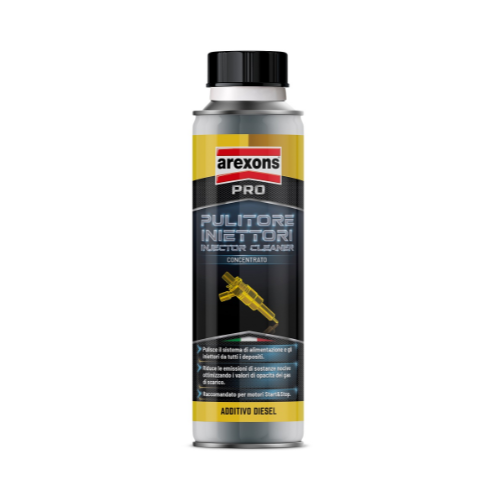
AREXONS 9844 – PROFESSIONAL DIESEL INJECTOR CLEANER (325 ML)
Professional concentrated additive for cleaning Mercedes CDI Common Rail injectors. Removes stubborn deposits, improves atomization, reduces smoke and consumption. Use for 2 consecutive treatments (with half a tank) before considering injector replacement. FAP/DPF and SCR compatible.
💰 Price: €10-14 · Dose: 325 ml for up to 60 L
✅ Step 4: Accelerator pedal check
If code P022664 persists after connector cleaning, the integrated pedal sensor is faulty. Replacing the entire pedal resolves 90% of P022664 cases, provided the electrical system is intact. Mercedes does not supply the sensor separately — the entire pedal assembly is replaced.
⚠️ Pedal reset after replacement: after installing a new pedal, the learning procedure must be performed. Mercedes has a standard procedure: key in position II (without starting), pedal pressed fully for 5 seconds, key to OFF, release pedal, wait 1 minute before starting. This recalibrates the minimum/maximum points.
🛠 6. WHEN TO REPLACE INJECTORS AND ACCELERATOR PEDAL?
Replace injectors (cylinders 2 and/or 3) if:
- Codes P02023A and P02033A do not disappear after connector cleaning and additive
- The engine continues to run on 3 cylinders with marked vibrations
- Injectors show anomalous ohmic values during testing (more than 15-20% deviation from the average)
- The bench flow test confirms that one or more injectors are out of specification
- There is persistent black smoke during acceleration even after additive use
On CLAs with OM607 (1.5 dCi Renault, A180 CDI), OM651 (2.1 CDI) or OM640 (2.0 CDI) engines, injector cost varies between €80-180 per aftermarket unit of quality (€250-450 for original Bosch/Delphi/Continental).
Replace the accelerator pedal if:
- Code P022664 returns within 200-500 km after reset
- You have ruled out wiring, oxidation, and connector problems
- The car does not respond well to acceleration even after cleaning
- The signal test of the two potentiometers (with a professional OBD scanner) shows that one of the two values is out of range or flat
Aftermarket accelerator pedal cost for CLA C117/Class A W176: €150-300 + labor €40-80 (part replaceable in 30-45 minutes).
💬 Looking for the right accelerator pedal or injectors for your CLA? On Autoricambi Tritella you can request a free quote by providing your chassis number (VIN) and engine code: we will find the compatible part at the correct price.
💰 7. HOW MUCH DOES IT COST TO FIX IN 2026?
| Intervention | Cost | Notes |
|---|---|---|
| Professional Mercedes OBD diagnosis | €60-120 | Necessary to read Mercedes-specific codes |
| Connector cleaning (DIY) | €10-20 | Resolves 15-20% of cases |
| Arexons 9844 Additive (2 treatments) | €20-30 | Test before replacing injectors |
| Injector electrical test in workshop | €40-80 | Ohmic measurement + ECU signal test |
| Injector bench test (per unit) | €60-100 | Professional flow and sealing test |
| Aftermarket CDI injector replacement | €80-180 | Quality remanufactured Bosch/Delphi |
| Original CDI injector replacement | €250-450 | Original Mercedes, to be coded with Xentry |
| Labor for injector replacement (4) | €200-400 | Includes bench IMA coding |
| Accelerator pedal replacement | €150-300 | Aftermarket part + labor €40-80 |
| Original Mercedes accelerator pedal | €300-500 | If you prefer OEM with 2-year warranty |
| Injector wiring harness repair | €80-200 | When the error is on the electrical harness |
*Indicative prices May 2026, VAT included, workshop labor included. Variable based on area, engine type (OM607/OM651/OM640) and spare parts supplier.
💬 Do you have a workshop quote that seems high?
Send us the quote you received and the DTC codes. We'll help you check if the prices are in line with the 2026 market and find the right spare parts for your Mercedes CLA (CDI injectors, accelerator pedal, wiring harnesses) at correct prices — often saving 20-30% compared to the dealership.
📩 Request a free quote🧪 8. REAL CASE: MERCEDES CLA 234,000 KM
To provide a concrete reference, I will recount a real case that recently came to the workshop. Mercedes CLA 200 CDI with 234,000 km, engine light on, limp mode on first start-up. OBD reading: the three codes P022664, P02023A, and P02033A together.
Procedure applied:
- Connector cleaning with WD-40 Specialist on accelerator pedal (B37) and injectors → situation improves, but codes return after 50 km
- Injector ohmic test: cylinder 3 with resistance 0.3 Ω (out of range), cylinder 2 at lower limit (0.5 Ω), cylinders 1 and 4 nominal (0.9-1.1 Ω)
- Replacement of injectors 2 and 3 with quality remanufactured Delphi parts (€110 per unit) + IMA coding
- Code P022664 still present: accelerator pedal showed flat signal on potentiometer 2 during test
- Aftermarket accelerator pedal replacement (€180) + learning procedure
- Code reset and 30 km road test: all errors cleared, engine running smoothly
Total cost of intervention: approximately €750-850 including parts and labor. Cost avoided: at the dealership, it would have been a quote of €2,000-2,500 with original injectors.
💡 Lesson from the real case: at 234,000 km, it's normal for multiple components to fail simultaneously. Correct diagnosis at a specialized workshop (€60-120) allowed for targeted intervention, replacing only what was actually faulty instead of "all injectors + pedal + wiring" as often suggested to the inexperienced customer.
🔗 9. RELATED INSIGHTS
The complete guide to the Mercedes A-Class W176 CORE, platform shared with CLA C117
→ Read more
The other frequent fault on CLA models: dual-clutch transmission, 2026 costs, prevention
→ Read more
Technical comparison between Bardahl, Arexons, and Liqui Moly for Common Rail systems
→ Read more
❓ FREQUENTLY ASKED QUESTIONS
Can I drive with P022664 / P02023A / P02033A codes active?
Not recommended. The control unit may limit performance to protect the engine (limp mode), and faulty injectors can cause progressive damage to pistons, turbocharger, and SCR/DPF catalyst. If you need to drive to the workshop, go a few kilometers at moderate speed. If you see significant black smoke or feel strong vibrations, stop and have the car towed.
Is it okay if I only replace the faulty injector?
It depends on the mileage. Below 100,000 km, it might be sufficient. For Mercedes CLA models with over 200,000 km, I recommend testing all four injectors on the bench and replacing the weaker ones or those out of spec, even if they are not yet showing errors. Cylinders 2 and 3 often fail first (more thermally stressed), but 1 and 4 follow within 20-30,000 km.
Does injector cleaning with additive really work?
If the injectors are only dirty or slightly obstructed by carbon deposits, yes: two consecutive treatments with a professional additive like Arexons 9844 (€10-14) can restore correct atomization. However, if there is an electrical fault (out-of-range resistance), internal nozzle wear, or a burnt solenoid, no — physical replacement is needed.
Do I need to replace the accelerator pedal or can it be repaired?
The Mercedes accelerator pedal is a unibody assembly: the sensor with its two potentiometers is integrated into the pedal body and is not available as a separate spare part. The entire assembly must always be replaced. Aftermarket cost €150-300, original Mercedes €300-500. After installation, the learning procedure is mandatory.
How much does a complete repair at a workshop cost in 2026?
It depends on the actual cause. Simplest case (connector cleaning only): €60-150. Intermediate case (additive + 1 injector): €250-400. Complete case (2 injectors + pedal + labor + coding): €700-1,000 with quality aftermarket parts, up to €1,800-2,500 with all original Mercedes parts. A preliminary diagnosis at €60-120 avoids "shooting in the dark."
On which other Mercedes models can these codes appear?
In addition to the CLA C117, the same codes frequently appear on all models that share the MFA platform with CDI engines: A-Class W176 (A180 CDI, A200 CDI, A220 CDI), GLA X156 (GLA 200 CDI, 220 CDI), B-Class W246 (B180 CDI, B200 CDI). The most affected engines are OM607 (1.5 dCi Renault), OM651 (2.1 CDI), and OM640 (2.0 CDI).
After replacing the injectors, is IMA coding needed?
Yes, it is mandatory. Each Mercedes CDI injector has a 7-digit IMA (Injector Mass Adjustment) code printed on its body, which the engine control unit must memorize to compensate for manufacturing tolerances. Without coding, the engine will run irregularly even with new injectors. Coding is done with Xentry/DAS or a Mercedes-compatible scanner (Autel, Launch X431 with Mercedes license).
Can I reset the accelerator pedal without a scanner?
Yes, using the standard Mercedes procedure: key in position II (without starting the engine), pedal fully pressed for 5 continuous seconds, key in OFF while keeping the pedal pressed, release the pedal, wait 1 minute. This recalibrates the minimum and maximum points of the pedal and the transmission's shift points. It won't cause damage even if you get the procedure wrong.
📌 CONCLUSION
An illuminated engine light and codes P022664, P02023A, and P02033A on a Mercedes CLA or other compact diesel Mercedes models tell a precise technical story: there is an electronic anomaly on the accelerator pedal + a fault in the injector circuits of cylinders 2 and 3. It is almost never a matter of separate random faults: there is a common cause (wiring, oxidation, progressive wear due to mileage).
By acting in a targeted manner — professional OBD diagnosis, contact cleaning, electrical injector test, specific additive, any targeted replacements — the problem can be effectively resolved, avoiding unnecessary expenses and keeping the engine efficient for another 50,000-100,000 km.
The worst mistake is to "blindly" replace all injectors without diagnosis: you risk spending €2,000-2,500 when a targeted intervention of €250-400 would have been sufficient. For a free quote on specific spare parts for your CLA, you can contact us directly.


