

OPEL MOKKA ELECTRIC 2024–2025 – KNOWN DEFECTS, ACTUAL RANGE, CHARGING, AND SOFTWARE ISSUES
Discover all the known flaws of the 2024–2025 Opel Mokka Electric : real-world range, AC/DC charging issues, BMS limitations, and the most reported software bugs. The Opel Mokka Electric is one of the Stellantis group's most popular compact electric SUVs: bold styling, urban dimensions, and the same technical base as the Jeep Avenger Electric, Peugeot e-2008, and DS3 E-Tense.
At our parts store, we speak daily with customers, repair shops, and suppliers of all brands. We analyze warranty requests, recurring defects, charging issues, and concrete feedback on battery life and software. Seeing so many different cases allows us to understand the real strengths and weaknesses better than those who work solely on a single brand or model.
In this guide I want to explain to you clearly and honestly :
- what are the most reported defects on the 2024–2025 Opel Mokka Electric ;
- how BMS (Battery Management System), AC/DC charging and battery management really work;
- what is the difference between real summer/winter autonomy and the declared numbers;
- What are the technical limitations common to compact electric SUVs and how to best manage them in practice?
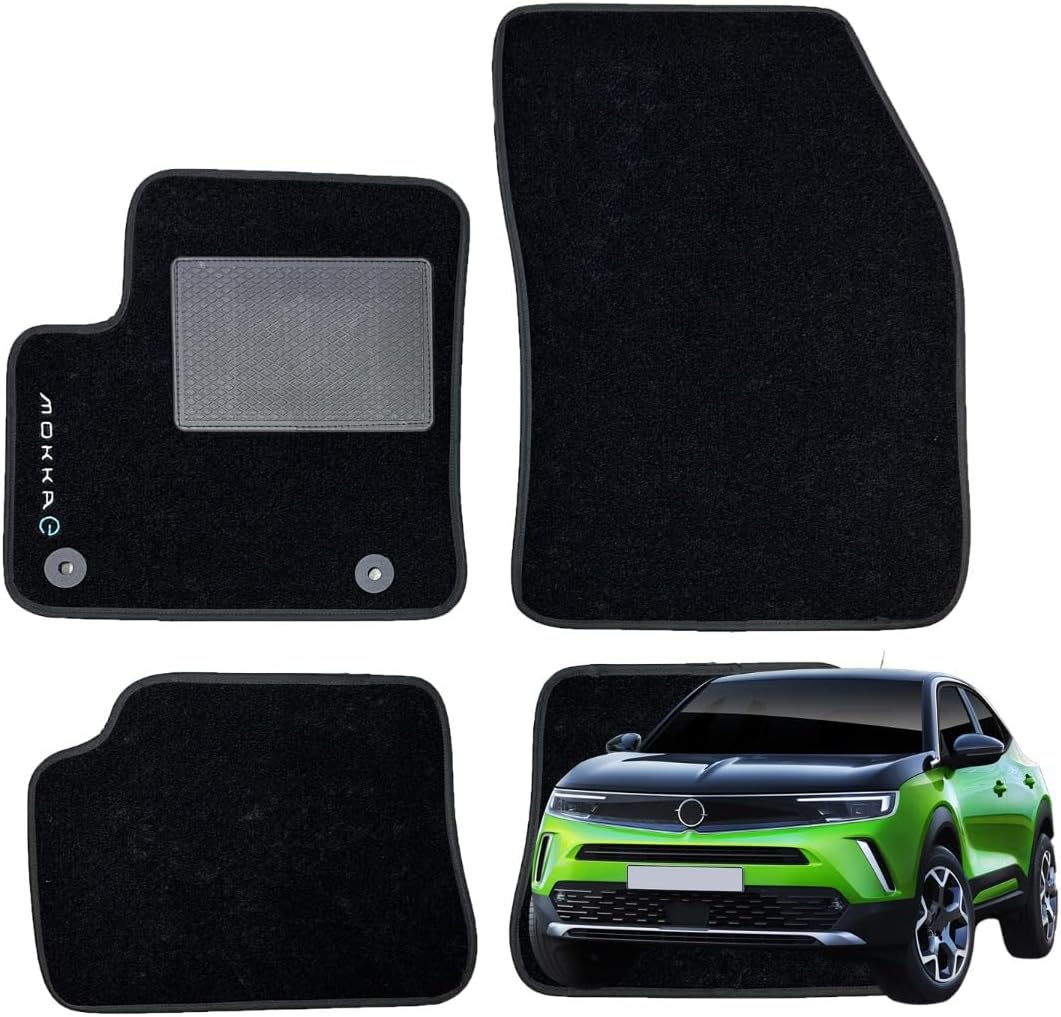
CARPET MATS – OPEL MOKKA ELECTRIC (2020→)
Complete set of 4 black carpet mats compatible with the Opel Mokka electric from 2020 onwards. Made from durable, non-slip materials, they ensure protection, comfort, and an elegant look for your vehicle's interior.
🛒 Buy now on AmazonCOMPARISON 2025: JEEP AVENGER ELECTRIC VS FIAT 600e VS PEUGEOT e-2008 VS OPEL MOKKA ELECTRIC
Want to understand how the Opel Mokka Electric really stacks up against other electric B-SUVs from the Stellantis group? In this technical comparison, we analyze the engine, battery, real-world range, charging, and features of the four models.
📘 Go to the complete comparison of electric B-SUVs📋 ARTICLE INDEX
- 👉 Opel Mokka Electric technical overview (engine, battery, platform)
- 👉 BMS and battery management: how it affects range and charging
- 👉 Actual summer/winter range: city, suburban, highway
- 👉 AC/DC charging: most common problems and compatibility of charging stations/wallboxes
- 👉 Infotainment, software, and ADAS: bugs reported
- 👉 Typical limitations of compact electric SUVs (not just the Mokka)
- 👉 Practical advice from a spare parts dealer for choosing and managing the Mokka Electric
- 👉 FAQ – Frequently asked questions about the Opel Mokka Electric
- 👉 Conclusions: for those who really make sense of the Mokka Electric
⚙️ OPEL MOKKA ELECTRIC 2024–2025: TECHNICAL OVERVIEW
🧭 Engine and platform
The 2024–2025 Opel Mokka Electric is based on Stellantis' e-CMP2 platform, the same platform used by the Jeep Avenger Electric, Peugeot e-2008, DS3 E-Tense, and other compact electric vehicles from the group. It's a solid, proven foundation, and well-known among workshops and spare parts dealers, but it comes with some well-known structural limitations in terms of weight, range, and thermal management.
- Front electric motor with approx. 115 kW / 156 hp ;
- high voltage battery of approximately 54 kWh net (just over 50 kWh actually usable);
- front-wheel drive with a more urban/road than off-road setting.
In practice it is a compact SUV designed especially for:
- daily use home-work and city;
- mixed urban/extraurban with some ring roads;
- longer journeys, but with the requirement to organize charging well and accept relatively frequent stops.
⚡ Theoretical autonomy and license plate data
- WLTP declared autonomy : around 400 km (depending on version, wheels, trim);
- urban use → with regular driving you can get close to 320–350 real km;
- motorway use → the range often drops to the 200–250 km real range.
Charging, on paper, is in line with the other electric B-SUVs of the group:
- Fast DC charging up to 100 kW → approximately 20–30 minutes to go from 20% to 80% on a suitable charging station;
- AC charging (7.4 kW home wallbox) → approx. 6–7 hours for a full charge.
✅ These are good numbers for the segment, but in everyday reality , temperature, driving style, quality of the charging stations and BMS strategies come into play, which can significantly change the sensations of use.
🔋 BMS (BATTERY MANAGEMENT SYSTEM) AND BATTERY MANAGEMENT
The BMS – Battery Management System is the “brain” that manages the battery of the Opel Mokka Electric. It decides:
- how much power can you use in acceleration;
- how fast can you charge (both AC and DC);
- how much of the battery's actual capacity is actually made available between 0% and 100% indicated on the display;
- How to protect cells in critical conditions (intense cold, very hot battery, repeated charging).
📉 How the BMS affects battery life and charging
- In winter, to protect the cells, the BMS can severely limit the fast charging power (e.g. instead of the theoretical 100 kW, you end up stuck at 30–50 kW until the battery is up to temperature);
- if the battery is very hot (summer, highway + frequent charging) you can reduce the charging speed to avoid excessive thermal stress;
- to extend battery life, a safety “buffer” is used: even when you read 0% or 100%, the battery is almost never at its real physical extremes;
- In some situations, users report a rapid drop in the first percentage points (e.g. from 100% to 93–95% in a few km), typical of many electric cars with a conservative BMS.
What we see as spare parts dealers and what feedback from workshops provides:
- Customers who tell us: “The first charge of the trip is fine, from the second onwards it no longer exceeds certain values” ;
- users who notice much slower charging in winter , even at the same charging stations, with the same initial percentage;
- some reports of reduced power when accelerating with a cold battery or at very low charge levels.
✅ This is rarely a “serious” design flaw, but rather the direct result of the BMS strategies chosen by Stellantis to protect the battery and minimize warranty failures.
❄️ REAL SUMMER/WINTER AUTONOMY: WHAT TO REALLY EXPECT
🏙️ Urban and mixed use
In the city and on mixed urban/extra-urban roads, with regular driving, the Mokka Electric performs well:
- in mild conditions (spring/autumn), many users report real-world ranges approaching 320–350 km on a charge;
- in harsh winter, with the heating on, it is normal to drop to around 250–280 km real, especially on short journeys with many starts/stops;
- In summer, with the air conditioning on, the impact is less drastic than in winter, but on very busy routes the range still drops compared to the WLTP.
🛣️ Highway use
On the highway, the situation changes radically, as with all electric B-SUVs:
- at constant speeds around 120–130 km/h, the range can drop to the 200–250 km real range in favourable conditions;
- with the climate on, full load, headwind or rain, it is not impossible to see values even below 200 km effective;
- the practical result is the need to stop to recharge every 180–220 km or so if you don't want to reach 5–10% battery and have to drive around in a panic trying to find a charging station.
🎯 What emerges from real cases
- Short city / mixed use → those who use it mainly in the city are generally satisfied: “I only need to charge it every 3–4 days, the battery life is adequate” ;
- “Motorway-grinder” use → those who use it for long motorway stretches are more critical: “For journeys of 500–600 km I have to stop often, it's not what I expected when I read the WLTP” .
✅ We are not talking about a defect exclusive to the Opel Mokka Electric , but an intrinsic technical limitation of compact electric SUVs with batteries of this capacity and a tall body.
⚡ AC/DC CHARGING: MOST FREQUENT PROBLEMS AND STATION/WALLBOX COMPATIBILITY
⛽ Fast DC charging (fast charging stations)
On paper, the Mokka Electric supports up to 100 kW in DC , but in practice:
- maximum power is achieved only on new generation DC columns , well maintained and with adequate power supply;
- battery temperature, initial state of charge and conditions of the charging station can significantly lower the effective power (e.g. stopping at 60–70 kW or even less);
- On older infrastructures , “handshake” errors (initial communication problems between the car and the charging station) are not uncommon, with charging not starting or interrupting after a few seconds.
From our observatory, between customers and workshops:
- reports of charging stations requiring a restart or change of stall to complete charging;
- typical phrases: “On certain fast models it immediately reaches 90–100 kW, on others it doesn’t go above 40–50 kW without a clear reason” ;
- In winter, many users notice that, arriving with a cold battery, the charge never really reaches the theoretical values .
🏠 AC charging and home wallbox
- with 7.4 kW wallboxes it usually takes 6–7 hours for an almost full charge (from 10–20% to 80–90%);
- Some older home wallboxes have required firmware updates to work properly with the Mokka Electric (disconnections, communication errors, charging stops);
- Customers often ask for quality, longer and more robust Type 2 cables to improve ergonomics and reliability in everyday use.
✅ Many "charging" problems can be reduced by choosing certified accessories (cables, adapters, wallboxes) right from the start and checking their actual compatibility with the car, instead of improvising with cheap generic products.
✅ Practical tips on charging
- First check the compatibility of the charging stations you will use most often (home, work, recurring trips);
- invest in a latest-generation home wallbox , upgradable via firmware and with serious technical assistance;
- in winter, if possible, reach fast charging after a stretch of road, so that the battery is not completely cold;
- Use quality cables and adapters , avoiding products without clear markings and certifications.
🖥️ INFOTAINMENT, SOFTWARE, AND ADAS: BUGS REPORTED
Like all new generation cars, the Opel Mokka Electric also has a strong electronic and software component:
- large central screen for infotainment and car settings;
- integration with Android Auto and Apple CarPlay , often even wirelessly;
- ADAS package with automatic braking, lane keeping, cruise control, sign recognition, etc.
💻 Most reported software and infotainment issues
- infotainment system sometimes slow or cumbersome , especially in the first few minutes after starting;
- lag in the main menus when quickly changing screens or using multiple functions in parallel;
- micro disconnects and delays with Android Auto and Apple CarPlay , especially when wireless;
- some rare sudden screen resets , often resolved with subsequent software updates.
🚗 ADAS and sensors
- Lane Assist perceived by many as very sensitive on Italian roads, with sometimes abrupt corrections or frequent warnings;
- the automatic braking system can be a little “nervous” in the city (sudden slowdowns, false alarms);
- Adaptive cruise control may become less responsive in bright sunlight or heavy rain, when the front camera is obstructed.
Feedback we often receive:
- “After the latest software update the infotainment has improved, but it's still not perfect” ;
- “At the dealership they advised me to do all the updates immediately before delivery.”
✅ We recommend requesting the latest software version when you pick up your car and periodically checking for updates, both over-the-air and in the workshop, especially in the early years.
⚠️ TYPICAL LIMITATIONS OF COMPACT ELECTRIC SUVS (NOT JUST MOKKA)
Many of the critical issues that motorists attribute to the Opel Mokka Electric are, in reality, common to all compact electric SUVs with a battery of around 50–55 kWh:
✅ High fuel consumption on the highway
- the significant weight and tall bodywork mean that, above 110–120 km/h, efficiency drops significantly;
- the result is a real autonomy on the motorway that is lower than the WLTP promises , with more frequent stops than with a thermal car.
✅ Trunk and habitability
- the battery pack in the floor raises the loading floor and leads to a compromise on the usable volume of the trunk;
- For heavy family use, it is a good idea to carry out real load tests (strollers, car seats, suitcases) before signing the contract.
✅ Out-of-warranty maintenance
- electronics is very complex and requires workshops equipped and trained in high voltage systems;
- the battery is usually covered by an extended warranty (up to 8 years) , but any interventions outside of this coverage have significant costs;
- Hasty or unskilled diagnoses can lead to misinterpretations of warning lights and error codes, resulting in unnecessary part replacements.
🛠️ PRACTICAL ADVICE FROM AN EXPERT SPARE PARTS DEALER
In our shop , we advise customers every day who want to make an informed choice , especially when it comes to 100% electric vehicles like the Mokka.
✅ 1. Check charging compatibility
- Find out in advance about the charging stations in your area (type of socket, power, operator, any parking costs);
- check the contracts and real costs of public charging (price per kWh, per minute, any overstay penalties);
- For your home wallbox, choose models that can be updated via firmware , with reliable technical support and compatible with your car's settings.
✅ 2. Software updates (BMS, infotainment, ADAS)
- Stellantis periodically releases software improvements for BMS, infotainment and ADAS;
- always ask for the latest available versions to be installed when you collect the car;
- Check periodically, via the app or official network, for pending updates and don't put it off too long.
✅ 3. Respect scheduled maintenance
- Electric also has important controls on:
- high voltage (HV) system ;
- battery cooling (liquid, pumps, circuits);
- electronic control unit diagnostics ;
- brakes, suspension and tyres, put to the test by the weight of the car.
- Always keep your service booklet up to date to avoid problems in the event of warranty claims on the battery and main components.
✅ 4. Evaluate your actual usage
- Urban use and ring roads → the Mokka Electric can be a very sensible choice, comfortable and with low mileage costs;
- Lots of highway → you need to plan your stops and accept longer travel times, or another engine may be more suitable;
- Before deciding, always do a long test drive on mixed routes (city, extra-urban, ring road) and, if possible, also try a fast charging .
❓ FAQ – FREQUENTLY ASKED QUESTIONS ABOUT THE OPEL MOKKA ELECTRIC
Is the real-world range of the Opel Mokka Electric really that low?
In the city and on mixed routes, with normal driving, range can be very close to the "sensible" values for the category , in the order of 300+ km in ideal conditions. On the highway, however, as with all compact electric SUVs with a battery of around 50–55 kWh, range decreases and you find yourself stopping every 200–250 km or so. This is not a defect of the individual car, but a physical limitation related to weight, aerodynamics, and battery capacity.
Why is fast charging sometimes slow or stops sooner than expected?
The most common causes are: non-ideal battery temperature , charging station not in perfect condition, infrastructure-related power limits, and BMS strategies to protect the cells. It's normal for the power not to immediately reach the theoretical maximum value in winter or after driving many kilometers on the highway with a warm battery. Some older charging stations may also experience "handshake" errors and sudden interruptions in charging.
Are the software and infotainment reliable?
Generally, yes, but like all modern systems, they are highly software-dependent and constantly evolving. Some bugs (lag, minor freezes, CarPlay/Android Auto disconnections) are fixed with software updates . For this reason, it's important to always keep your car up to date and perform periodic checks on an official network, especially in the early years of the model's life.
Is the Opel Mokka Electric suitable for those who drive a lot on the motorway?
It can be, but only if you accept and plan frequent charging stops and if the infrastructure you regularly use is reliable. If you frequently travel long distances (e.g., 500–700 km in a day) and don't want to organize the stops, another type of engine (hybrid, plug-in, or internal combustion engine) is likely more suited to your actual needs.
Is it worth buying a used Opel Mokka Electric?
It may be a good idea if, before signing, you: • check the maintenance history and software updates performed; • check the battery condition through diagnostics (SOH, any errors, number of cycles); • do a complete road test, including a stretch of highway and, if possible, a fast charge. Without these checks, you risk taking home a car that isn't suited to your actual use or that requires costly repairs in the short term.
✅ CONCLUSIONS: FOR THOSE WHO REALLY MAKE SENSE, THE OPEL MOKKA ELECTRIC
The 2024–2025 Opel Mokka Electric is a mature proposition for those looking for a compact, city-focused, zero-emission SUV , with:
- lively and silent driving in city traffic;
- adequate urban autonomy for home-work, errands and city trips;
- Fast charging in line with the segment when using modern and well-maintained infrastructure.
At the same time, it must be chosen with awareness :
- real autonomy on the motorway is significantly lower than the WLTP values and requires planning of stops;
- software, BMS and charging infrastructures are still undergoing constant refinement and are not always 100% perfect;
- The build quality is good but not premium: some creaks or small finishing defects may emerge, especially on the first batches.
As expert spare parts dealers, we always recommend getting well-informed , talking to those who have already purchased one, and planning your electric mobility realistically. Only then will you be able to truly enjoy the Mokka Electric, avoiding false expectations and unpleasant surprises after the purchase.
SPARE PARTS AND TECHNICAL SUPPORT FOR THE OPEL MOKKA ELECTRIC
If you own an Opel Mokka Electric and are looking for support for charging cables, wallboxes, suspension components, brakes, or body parts , we can help you find the right products based on your chassis, year, and trim level . This way, you can avoid compatibility errors, wasted time, and unnecessary purchases.
🛒 Go to the Tritella Auto Parts shop2025 Car Battery Ranking: AGM vs. AFB
Want to better understand advanced battery technologies and how they impact starting and energy management in modern cars?
🔋 Read the AGM vs. AFB guideFiat Panda Hybrid Battery Charging Problems
Another real-world case of a charging issue on a popular urban hybrid, with causes and solutions clearly explained.
⚙️ Go to the article on the Panda HybridLow-cost maintenance for the Dacia Sandero
For those considering cheaper alternatives: a practical guide to service costs and savings strategies for one of the most popular cars.
📉 Find out how to save on maintenance


