

Skip to content Home › Vehicle Issues and Breakdowns › Clogged 1.5 BlueHDi DPF
2026 technical guide dedicated to the most common problem of the 1.5 BlueHDi PSA/Stellantis: particulate filter (DPF/FAP) clogging. We analyze real causes, symptoms, DTC codes, professional diagnosis, updated costs, and the connection with the timing chain recall.
A clogged DPF is the most frequent reason for workshop visits for those who drive a 1.5 BlueHDi. It is not a "defect" of the engine itself, but the result of a mismatch between modern technology and typical Italian urban use. In this article, we analyze why it happens, how to recognize the first symptoms, how much it costs to intervene in time, and why this problem is linked to the timing chain recall that is the subject of the Stellantis 2023-2025 campaign.
Also read: 1.5 BLUEHDI ENGINE: PROBLEMS, TIMING CHAIN RECALL, AND MAINTENANCE (2026 GUIDE) — the cluster's pillar guide.
STELLANTIS 1.2 PURETECH GEN 3 RECALL (2023–2025): FIRE RISK, AFFECTED MODELS, SYMPTOMS, AND WHAT TO DO IMMEDIATELY
Do you own a Peugeot, Citroën, Opel, DS, Fiat, or Jeep with a latest-generation 1.2 PureTech engine? Stellantis has initiated a recall for a possible fire risk due to fuel leaks from the high-pressure line. In the article, I explain the affected models, symptoms, real risks, and what to do immediately.
Read the recall articleTechnical article by Gianni Tritella – real diagnosis from workshops and official Stellantis data.
🚦 1. WHY THE DPF CLOGS IN 1.5 BLUEHDI ENGINES
The 1.5 BlueHDi PSA/Stellantis engine (Peugeot, Citroën, DS, Opel, Fiat, Jeep, Toyota) is an efficient Euro 6d diesel, but the particulate filter (DPF/FAP) is a known weak point. The causes of clogging are multiple and often concomitant:
Usage-related causes
- Frequent urban use: short journeys do not allow the engine to reach regeneration temperature (~600°C at the exhaust gases)
- Interrupted regenerations: turning off the car during the active cycle blocks internal cleaning and exacerbates soot accumulation
- Continuous Stop&Go: typical of Italian traffic, the engine does not maintain stable speeds for long enough
- Overly gentle driving style: even on the highway, consistently driving at low RPMs can prevent passive regeneration
Related technical causes
- Dirty injectors: imperfect combustion → more particulate produced → DPF loads up faster
- Clogged EGR valve: irregular recirculation → altered air/diesel mixture → increased soot
- Declining turbo performance: lower pressure = less efficient combustion
- Faulty DPF differential pressure sensor: the ECU "believes" the filter is clogged when it isn't, or vice versa
- Exhausted Eolys additive (on versions with Eolys system)
- AdBlue/SCR problems: alter the regeneration strategy
- Low-quality diesel: contains more impurities and sulfur compounds
💡 In our workshop experience: the DPF rarely clogs "on its own". In 70% of cases, there is a combination of several causes (slightly dirty injectors + urban use + mediocre diesel + delayed servicing). This is why the diagnosis must be systemic, not limited to the filter alone.
⚠️ 2. SYMPTOMS AND SEVERITY
Symptoms of a clogging DPF appear progressively. Recognizing them in time makes the difference between a €100 intervention and a €1,500 replacement.
| Symptom | DPF Status | Urgency |
|---|---|---|
| Slight increase in fuel consumption (+5-10%) | DPF progressively loading | Low — encourage regeneration |
| Radiator fan on after shutdown | Active regeneration in progress | Normal — DO NOT turn off the engine |
| Intense burning diesel smell | Repeated regenerations | Medium — check within 1 month |
| Yellow engine light on | Anti-pollution system error | Medium-High |
| "Anti-pollution fault" message | DPF heavily loaded, regeneration failed | High — immediate diagnosis |
| Emergency mode (limp mode), reduced power | DPF saturated | Very High — stop car |
| Abnormal dark smoke from exhaust | DPF broken or bypassed | Very High — risk of vehicle breakdown |
| Increasing oil level on dipstick | Oil dilution from failed regenerations | Very High — engine risk |
Related AdBlue insights: ADBLUE PROBLEMS ON PEUGEOT 208, 308, 3008, AND 5008.
📟 3. MOST FREQUENT DTC CODES
OBD readers detect specific DPF-related errors. Here are the ones we see most often on the 1.5 BlueHDi:
| Code | Meaning | First diagnostic action |
|---|---|---|
| P2002 | DPF efficiency below threshold | Check differential pressure, sensor, DPF status |
| P2459 | DPF regeneration too frequent | Upstream causes: EGR, injectors, combustion |
| P244A / P244B | Differential pressure out of range | Check DPF pressure sensor and tubes |
| P2453 | DPF pressure sensor malfunction | Replace sensor or clean connector |
| P242F | DPF ash accumulation maximum limit | Professional cleaning or replacement |
| P1435 (PSA) | DPF regeneration not completed | Forced regeneration + check upstream causes |
| P0420 | Catalyst efficiency below threshold | Lambda sensor or catalyst (not direct DPF) |
Specific insights: P2002 DPF EFFICIENCY BELOW THRESHOLD · P2459 EXCESSIVE DPF REGENERATIONS.
🔥 4. HOW REGENERATION WORKS
The DPF cleans itself by burning accumulated particles. There are two regeneration modes:
Passive regeneration
Occurs automatically during long highway drives when the natural heat of the exhaust gases exceeds 350-400°C. It does not require ECU intervention — particulate matter burns spontaneously.
Required conditions: constant speed above 70 km/h, at least 15-20 minutes, warm engine.
Active regeneration
The ECU intervenes by injecting extra diesel fuel in post-injection to raise the exhaust gas temperature to ~600°C and burn off residues. The cycle lasts 15-25 minutes and requires stable conditions.
How to recognize an active regeneration in progress:
- Idle speed higher than normal (900-1,000 rpm instead of 750-800)
- Radiator fan running harder
- Slight smell of burning diesel
- Higher instant fuel consumption if displayed
- Possible exhaust pulsation
⚠️ Critical error: turning off the engine during an active regeneration is one of the main causes of DPF clogging. If you notice the signs above, continue driving for another 15-20 minutes at a constant speed before parking.
If both regenerations (passive and active) repeatedly fail, the DPF loads beyond its limit, and the ECU puts the car into recovery mode. At that point, workshop intervention is required.
🔍 5. PROFESSIONAL WORKSHOP DIAGNOSIS
When the DPF is clogged, a serious diagnosis must go beyond simply reading error codes. Here are the steps we see performed in workshops:
1. Reading live OBD parameters
- DPF differential pressure: at warm idle, it should be 5-15 mbar. Above 30 mbar = confirmed clogging
- Pre and post DPF temperature: during regeneration, it must rise to 550-650°C
- Calculated soot accumulation (g): the DPF enters regeneration at around 20-30 g, physical limit 45-50 g
- Number of regenerations since last one: if it's over 100-150 km without regenerating = problem
- Distance between regenerations: indicative of the actual soot "load"
2. Physical inspection
- Check integrity of pressure pipes and sensors
- Visual inspection of connectors and wiring
- Inspection for hot gas leaks
3. Forced regeneration test
- A controlled regeneration is initiated via diagnostic tool
- If the DPF responds and pressure drops = filter is recoverable
- If it does not respond or pressure is stable = saturated filter, cleaning or replacement needed
4. Engine oil evaluation
- Check dipstick level (increasing level = dilution from failed regenerations)
- Oil quality analysis if contamination is suspected
- Important on 1.5 BlueHDi due to connection with timing chain/belt
🔗 6. THE CONNECTION WITH THE TIMING CHAIN RECALL
This is a point many ignore but is fundamental for the 1.5 BlueHDi: DPF, oil, and timing chain are in a chain of causes and effects. Here's how.
The vicious cycle of the BlueHDi in the city
- The car only makes short urban journeys
- DPF regenerations do not complete
- The ECU forces repeated regenerations in post-injection
- Part of the diesel injected into post-combustion leaks into the engine oil
- The oil dilutes and loses lubricating capacity
- The contaminated oil attacks the wet timing belt (premature degradation)
- The contaminated oil accelerates the wear of the internal timing chain subject to the Stellantis recall
- The ultimate damage is much more severe than just a clogged DPF
💡 Practical consequence: on a 1.5 BlueHDi, a neglected DPF is not just a DPF problem. It's a fuse that can accelerate timing chain failure and void the Stellantis 10-year/240,000 km extended warranty. Those who use the car in the city must be even more rigorous about DPF maintenance and oil changes.
For details on the correct oil (mandatory FPW9.55535/03) and the extended warranty, read: 1.5 BLUEHDI DV5R RECALL: QUARTZ INEO RCP OIL AND 10-YEAR WARRANTY.
🧭 7. HOW TO PREVENT CLOGGING
Those who frequently use their car in the city can drastically reduce the risk by following these habits:
- Weekly extra-urban journey: at least 20-30 km at a constant speed above 70 km/h to promote passive regeneration
- Do not turn off during regeneration: if you recognize the signs (high rpm, strong fan), continue driving for another 15-20 minutes
- Keep EGR and injectors efficient: preventive cleaning every 60-80,000 km
- Use quality diesel: reliable stations, avoid "low-cost" fuel of questionable origin
- Specific DPF additives: reduce regeneration temperature and help with short journeys
- Regularly check AdBlue levels and never let it drop below 20%
- Change engine oil with FPW9.55535/03 specification every 10,000-15,000 km (not 25,000-30,000 km as per manual)
- Check oil level on the dipstick monthly: if it increases = regenerations with oil dilution in progress, urgent diagnosis
Product insights: WHAT IS THE BEST ADBLUE ON THE MARKET? · RECOMMENDED ADDITIVES FOR BLUEHDI AND MODERN DIESEL ENGINES.
🔧 8. SOLUTIONS AND REAL COSTS
If the warning light comes on and the car enters emergency mode, intervention options vary in cost and effectiveness. Below are the average ranges for 2026 Central Italy (variable ±15% by area and model).
| Intervention | When to do it | Cost |
|---|---|---|
| Preventive DPF additive | First signs, urban use | €15-30 |
| Forced regeneration (diagnosis) | Warning light on, DPF not too clogged | €80-150 |
| On-site DPF chemical cleaning | DPF clogged but recoverable | €150-300 |
| Professional removal and cleaning | Ash accumulation, efficiency below threshold | €300-500 |
| Aftermarket DPF replacement | DPF broken or irreparably saturated | €800-1,500 |
| Original DPF replacement | Car under warranty or with original request | €1,500-2,500 |
| DPF pressure sensor replacement | Codes P244A/P244B/P2453 | €80-180 |
💡 Workshop tip: even if the DPF is the "culprit" component, before replacing it, it is always advisable to solve the underlying causes (EGR, injectors, sensors). Otherwise, the new DPF will clog in a few months.

VALVOLINE DPF CLEANER SPRAY – 887070
Professional spray for cleaning the diesel particulate filter (DPF/FAP) without disassembly. Removes deposits and soot from inside the filter, restoring the efficiency of the diesel system. Ideal as a corrective intervention before more expensive solutions.
🛒 Buy now on Autoricambi Tritella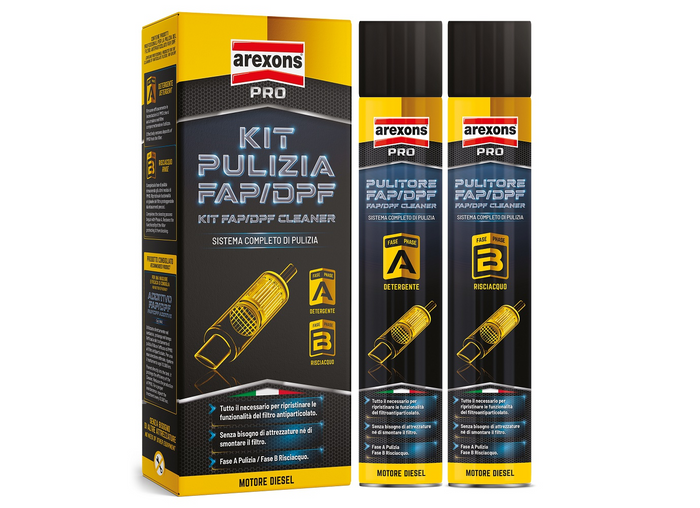
AREXONS 3705 – FAP/DPF CLEANING KIT
Complete kit for preventive particulate filter maintenance. Cleans and regenerates the FAP/DPF without disassembly, reducing consumption and emissions. Ideal as a preventive treatment every 10,000-15,000 km for cars used predominantly in urban environments.
🛒 Buy now on Autoricambi TritellaRead also: BEST ADDITIVE FOR FAP CLEANING: 2026 GUIDE.
🚫 9. WHAT NOT TO DO (DPF REMOVAL)
In Italy, DPF removal (commonly called "sgrugnamento" or "delete") is a widespread but illegal practice. It is not recommended for several reasons:
Legal consequences
- Violation of Highway Code art. 78: modification to structural characteristics
- Penalties: from €430 to €1,731 + suspension of vehicle registration certificate
- Homologation revocation: the car can no longer circulate until restoration
- Failed inspection: periodic inspections measure particulate levels
- Insurance freeze: in case of an accident with a tampered DPF, the insurance company may claim recourse
Practical consequences
- Environmental ZTLs: impossible to enter cities with restrictions (Milan Area B/C, Rome ZTL green zone, etc.)
- Compromised used car sales: informed buyers refuse or ask for significant discounts
- Warranty voided: if the car is still covered by any warranty, removal invalidates it
- Increased emissions: significant environmental impact
⚠️ Our advice: even if DPF removal seems like the "easy solution" to the problem, it is a legal and financial risk that is not worth taking. A properly maintained or replaced DPF costs less than the sum of the penalty + restoration + loss of car value.
⏳ 10. HOW LONG A DPF LASTS AND WHEN IT SHOULD BE REPLACED
The DPF is not an "eternal" component. It has a limited service life that depends on use, maintenance, and fuel quality.
Average service life
- Predominantly motorway use: 250,000-300,000 km before necessary replacement
- Mixed use: 180,000-220,000 km
- Predominantly urban use: 120,000-160,000 km
- Urban use without maintenance: can fail as early as 80,000-100,000 km
How to tell if the DPF is at the end of its life
- Increasingly frequent regenerations (every 100-150 km instead of 300-500)
- Increasing ash accumulation even after professional cleaning
- Recurring P2002 / P242F codes even after interventions
- Persistently high differential pressure even with a "clean" filter
- General engine efficiency loss despite correct maintenance
When this moment comes, replacement is inevitable. Choosing quality aftermarket DPFs (brands like NGK, Klarius, Imasaf, Eberspacher) can halve the cost compared to the original Stellantis without compromising on quality.
❓ FREQUENTLY ASKED QUESTIONS
How often does the DPF regenerate on the 1.5 BlueHDi?
On average every 300-500 km, but it depends on driving style, routes taken, and maintenance status. In the city, it may be necessary every 150-200 km. On the highway, it may not activate for thousands of km (passive regeneration prevails).
Can I drive with a clogged DPF?
Only for short distances and to reach the workshop. In emergency mode, the engine is limited, and continuing for too long can cause more serious damage: oil contamination, turbocharger failure, accelerated chain wear. Do not postpone diagnosis.
Do additives really work?
Yes, if used correctly and in the right conditions. They lower the regeneration temperature and help with short trips. They do not replace extra-urban driving: they are a complement, not a replacement. It's better to use them preventively than in an emergency.
How long does a DPF on a 1.5 BlueHDi last on average?
Between 120,000 and 300,000 km depending on use. In intense urban use without maintenance, it can fail even at 80,000 km. With correct maintenance and a reasonable urban/extra-urban mix, 200,000 km is a realistic goal.
Can the DPF be "cleaned" without disassembly?
Yes, through professional additives like Valvoline DPF Cleaner or Arexons FAP Cleaning Kit. It works well on partially clogged filters (up to ~70% saturation). For completely saturated filters, professional cleaning with disassembly is required.
Is DPF removal really illegal?
Yes, absolutely. It is a violation of Article 78 of the Highway Code, punishable by a fine of €430 to €1,731 + suspension of the vehicle registration document. The car cannot circulate or pass inspection. We strongly advise against this practice.
Is the DPF problem related to the Stellantis chain recall?
Yes, indirectly but significantly. Failed DPF regenerations cause oil dilution → degraded oil → accelerated chain wear. Those who neglect the DPF risk aggravating the chain problem subject to the recall. Using FPW9.55535/03 oil and maintaining an efficient DPF are two mutually reinforcing strategies.
How much does it cost to replace the DPF on a 1.5 BlueHDi?
2026 Range: €800-1,500 with a quality aftermarket DPF, €1,500-2,500 with an original Stellantis. In both cases, before replacing, it is advisable to resolve the root causes (EGR, injectors, pressure sensor) to avoid the new filter clogging again in a few months.
🏁 CONCLUSIONS
The 1.5 BlueHDi is not a faulty engine, but it suffers from urban use with incomplete regenerations. The DPF is the "safety valve" for all upstream problems: injectors, EGR, fuel quality, driving style. With a correct diagnosis and preventive maintenance, the risk of clogging and costly replacements can be drastically reduced.
The three key takeaways:
- Don't ignore the first symptoms: a €150 intervention today avoids a €1,500 expense tomorrow
- The DPF is not isolated from the rest of the engine: on a 1.5 BlueHDi, it is connected to oil, chain, and extended warranty
- Never remove the DPF: it is illegal, compromises car sales, and ZTLs
Do you have DPF problems? Contact us via WhatsApp or request an online quote: we will advise you on the most economical solution based on the actual condition of your filter.


