

EXCESSIVE ENGINE OIL CONSUMPTION IN THE 1.2 PURETECH: CAUSES, RISKS AND REAL SOLUTIONS
📅 Updated May 2026 · 🔧 Technical analysis based on 15 years in workshop and hundreds of EB2/EB2DT/EB2ADT engines monitored for abnormal oil consumption
Quick Answer
The 1.2 PureTech experiences abnormal oil consumption due to two distinct causes recognized by Stellantis: defective piston rings on turbo engines produced between April 2014 and July 2018 (pre-Euro 6.2), and oil separator malfunction on Euro 6.2 engines produced between February 2018 and February 2023. Abnormal threshold: over 0.5 L per 1,000 km. Stellantis offers an extended 10-year / 180,000 km warranty and retroactive refunds for expenses incurred between 2022 and 2024.
In recent years, we have seen an increasing number of 1.2 PureTech engines in our workshop with an underestimated yet potentially devastating problem: excessive engine oil consumption. Many owners report topping up in the order of 1 litre per 1,000 km or even less. In this guide, updated to May 2026, you will find the technical causes broken down by production year, the most frequent DTC codes, real workshop costs, and what to do to avoid a full engine overhaul costing over €6,000.
🔎 Want a complete overview of 1.2 PureTech engine problems?
Excessive oil consumption is just one of the critical points of this engine. In a dedicated guide, we analyze all the main problems of the 1.2 PureTech: oil-immersed belt, Gen3 recalls, costs, and at-risk versions.
👉 Read the full guide on 1.2 PureTech problems📏 WHEN IS OIL CONSUMPTION TRULY ABNORMAL?
Stellantis declares an acceptable oil consumption for the 1.2 PureTech to be a maximum threshold of 0.5 litres per 1,000 km. Beyond this value, we are talking about abnormal consumption that requires technical diagnosis. For guidance:
| Oil consumption | Assessment | What to do |
|---|---|---|
| Less than 0.2 L / 1,000 km | ✅ Normal | Check level at service |
| 0.2 – 0.5 L / 1,000 km | ⚠️ Monitor | Check level every 1,500 km |
| 0.5 – 1 L / 1,000 km | 🟠 Abnormal | Mandatory diagnosis |
| Over 1 L / 1,000 km | 🔴 Critical | Immediate intervention |
A PureTech that consumes 1 litre every 1,000 km over 15,000 km of annual mileage requires 15 litres of oil per year: over €200 just for lubricant, not counting the damage that accumulates in the engine.
🔍 WHAT ARE THE SYMPTOMS OF ABNORMAL OIL CONSUMPTION?
Oil consumption in the 1.2 PureTech rarely manifests with immediate warning lights. In most cases, the signs are gradual and should be caught in time:
- oil level dropping rapidly between services (check with dipstick every 1,500 km);
- "low oil level" message on the instrument cluster between oil changes;
- low oil pressure warning light illuminated, especially when hot or uphill (serious alarm: stop the car immediately);
- grey-blue smoke from the exhaust, especially during acceleration after deceleration or when the engine is hot;
- smell of burning oil in the engine bay, especially after mixed driving;
- loss of power and increased fuel consumption by 5-10% due to inefficient combustion;
- DTC misfire codes (P0301-P0304) due to fouled spark plugs from burning oil.
A common mistake we see in the workshop: considering high consumption "normal" and continuing to drive, only topping up. Every 1,000 km driven with oil below the threshold accumulates wear on bearings, crankshaft, and turbo. With 50,000 km of incorrect management, a complete engine overhaul is almost inevitable.
⚙️ WHAT ARE THE TECHNICAL CAUSES OF OIL CONSUMPTION?
The causes of oil consumption in the 1.2 PureTech are three, technically distinct. Stellantis itself has officially recognized them in its reimbursement campaigns, distinguishing them by production period.
1. Defective piston rings (pre-Euro 6.2 turbo engines)
On 1.2 PureTech turbo engines with codes EB2DT (110 hp) and EB2DTS (131 hp) produced between April 2014 and July 2018, the defect is concentrated on the piston rings (the segments that ensure sealing between the piston and cylinder).
In affected engines, the rings:
- lose elasticity prematurely due to abnormal thermal stress;
- become stuck in their seats due to carbon residues (coke effect);
- no longer ensure the sealing of the oil film in the combustion chamber;
- oil is drawn into the chamber and burned along with the air-fuel mixture.
The phenomenon is aggravated by urban use with short journeys (engine never reaching the operating temperature of 90°C) and the use of non-PSA approved oils.
2. Inefficient oil vapour separator (Euro 6.2 and later engines)
On 1.2 PureTech turbo Euro 6.2 or later engines, produced between February 2018 and February 2023, the main cause is the malfunction of the oil separator (vapour decanter).
The decanter is responsible for separating oil from the vapours that exit the engine block before returning them to the intake manifold (PCV system). When it loses efficiency:
- an excessive amount of oil is drawn into the manifold;
- the oil ends up in the combustion chamber and is burned;
- deposits form on the intake valves, throttle body, and turbo;
- in the medium term, injectors and spark plugs become fouled, further worsening consumption.
The problem is structural in nature: even with perfect maintenance, the decanter can fail, and it is one of the faults specifically covered by the extended Stellantis warranty.
3. Oil dilution due to urban use and unapproved oils
On both engine families, a cause that exacerbates the other two is the oil dilution typical of urban use. When the engine does not reach 90°C operating temperature:
- unburnt fuel drains into the sump and dilutes the oil;
- the oil loses viscosity and lubricating properties;
- internal wear increases and sludge formation accelerates;
- if "universal" oils not approved to PSA B71 2312 are used, the additives do not withstand the PureTech's work cycle.
Further reading: WHAT IS THE CORRECT OIL FOR THE 1.2 PURETECH and HOW OFTEN TO CHANGE THE OIL.

TOTAL QUARTZ INEO RCP 5W-30 — PSA B71 2312 APPROVED OIL
Total Quartz INEO RCP 5W-30 synthetic oil with official PSA B71 2312 approval, the standard required by Stellantis for 1.2 PureTech engines. Low SAPS formula compatible with DPF/GPF, reduces friction and sludge formation. Using the correct oil is the first concrete lever against abnormal oil consumption.
🛒 Buy on Autoricambi Tritella📅 WHAT CHANGES BY PRODUCTION YEAR?
Understanding your PureTech's production period is crucial: the cause of oil consumption changes, and consequently, so does Stellantis's coverage. Here is the official reference table.
| Engine type | Production period | Cause of oil consumption | Engine codes |
|---|---|---|---|
| PureTech 1.2 naturally aspirated | Jun 2012 – Jun 2022 | Oil dilution + urban use | EB2 (82 hp) |
| PureTech 1.2 turbo pre-Euro 6.2 | Apr 2014 – Jul 2018 | Piston rings | EB2DT (110 hp), EB2DTS (131 hp) |
| PureTech 1.2 turbo Euro 6.2+ | Feb 2018 – Feb 2023 | Defective oil separator | EB2ADTD (101 hp), EB2ADTX |
| PureTech 1.2 Gen3 chain | From 2023 | Rare cases, generally not structural | EB2ADTS, EB2ADTD MHEV |
The exact engine code can be found under item P5 of the vehicle registration document. This is the key data to understand which category applies to your vehicle, both for diagnosis and for potentially activating the extended warranty.
🔢 WHICH DTC CODES INDICATE OIL CONSUMPTION ON THE PURETECH?
Abnormal oil consumption does not generate a dedicated DTC code, but it produces a series of secondary codes that we regularly see in PureTech diagnostics in our workshop:
- P0420 – catalyst efficiency below threshold (burnt oil polluting the monolith);
- P0301 / P0302 / P0303 / P0304 – misfire for cylinder 1/2/3/4 (spark plugs fouled by oil);
- P0171 – lean mixture (oil in the manifold alters the stoichiometric ratio);
- P2187 – lean mixture at idle (symptom of excess oil vapours from the decanter);
- P0014 / P0341 – camshaft timing (in advanced cases due to camshaft wear from insufficient lubrication);
- P0299 – turbo underpressure (turbocharger suffering from insufficient oil).
If your PureTech presents more than one of these codes simultaneously, it is very likely that oil consumption is in an advanced stage. A thorough OBD-II diagnosis is the first step before intervention.
🚨 WHAT RISKS DOES THE ENGINE FACE IF I IGNORE THE PROBLEM?
An engine that constantly operates with a low oil level does not "get used to it": it accumulates damage. The risks increase with mileage driven below the threshold.
Accelerated wear on bearings and crankshaft
Insufficient lubrication compromises the main and connecting rod bearings and the crankshaft's sliding surfaces. This quickly leads to:
- abnormal play on the shaft (beyond the 0.05 mm tolerance);
- metallic noises at idle, especially when hot;
- in severe cases, connecting rod seizure with an irreparable engine.
Damage to the turbocharger
The turbo is one of the first components to suffer. With low oil pressure:
- friction increases on the impeller shaft;
- heat dissipation is reduced (the turbo operates at over 800°C);
- the risk of seizure increases rapidly;
- a turbo replacement costs €1,400-€2,000 in an independent workshop.
Compromised catalytic converter and GPF
Burnt oil leaves ceramic residues that clog the catalytic converter and the gasoline particulate filter (GPF). A complete replacement of the catalytic exhaust system costs €800-€1,500.
Final outcome: engine overhaul or replacement
If oil consumption is ignored for tens of thousands of kilometres, the most frequent outcome is a complete engine overhaul (rings, bearings, timing) starting from €3,500 and reaching over €5,000. In the worst cases, a complete engine replacement is necessary: €6,000-€10,000 for parts and labour.
💰 HOW MUCH DOES IT COST TO INTERVENE ON OIL CONSUMPTION?
Costs vary greatly based on the specific cause and channel (independent workshop vs. official Stellantis network). Here are the real prices observed in May 2026 in Italy.
| Intervention | Independent workshop | Official Stellantis network |
|---|---|---|
| OBD-II diagnosis + consumption check | €50-€90 | €80-€150 |
| Internal engine cleaning (additive + oil change) | 90-140€ | 150-220€ |
| Replacement of oil vapor separator | 180-280€ | 280-450€ |
| Replacement of piston rings | 1,800-2,500€ | 2,500-3,500€ |
| Complete engine overhaul | 3,500-5,000€ | 4,500-6,500€ |
| Complete engine replacement | 6,000-8,500€ | 7,500-10,000€ |
The difference between a preventative cleaning costing 100€ and an engine overhaul costing 5,000€ is why we always say the same thing in the workshop: monitoring oil levels every 1,500 km is not an exaggeration, it's the difference between manageable maintenance and an economic disaster.
🛡️ DOES STELLANTIS COVER OIL CONSUMPTION UNDER WARRANTY?
Yes. As of March 2024, Stellantis has activated extraordinary coverage for previous generation PureTech 1.0 and 1.2 engines. The extended warranty covers 100% of costs (parts + labor) for up to 10 years or 180,000 km from first registration, provided that maintenance has been regular.
For oil consumption, coverage specifically includes:
- excessive oil consumption due to carbon buildup or separator malfunction;
- consequent damage to piston rings;
- indirect damage to the turbo, oil pump, and vacuum pump.
Retroactive reimbursement for expenses 2022-2024
If you have already paid out of pocket for repairs due to anomalous oil consumption between January 1, 2022, and December 31, 2024, you can request a total or partial reimbursement on the stellantis-support.com platform. Required documents:
- invoices for the last 3 maintenance services;
- complete maintenance booklet;
- technical diagnosis signed by an authorized Stellantis workshop;
- maximum tolerance of 3 months or 3,000 km delay in services.
Check+ Program
If the last 3 services have been performed regularly (even at independent workshops, provided they follow the Stellantis maintenance plan), you can obtain the Check+ certificate free of charge. The certificate:
- officially extends coverage to 10 years / 180,000 km;
- covers anomalous oil consumption from carbon buildup or separator;
- is transferable upon sale, increasing the car's residual value by 500-1,500€.
Further details: complete guide to 1.2 PureTech problems with recall and warranty details.
🛠️ HOW TO PREVENT ANOMALOUS OIL CONSUMPTION
For PureTech engines, prevention makes a huge difference. Here are the seven concrete rules we apply in the workshop:
- Check the oil level every 1,000-1,500 km, especially if you mainly use the car in the city. Note it down: you'll immediately see if consumption increases.
- Reduce the oil change interval to 10,000-12,000 km (or once a year) instead of the 20,000-25,000 km specified in the manual. For PureTech engines, this is one of the most effective levers.
- Only use oils approved with PSA B71 2312 homologation (Total Quartz INEO RCP 5W-30 is the reference standard). Universal "compatible" lubricants cannot withstand the PureTech's operating cycle.
- Preventative internal engine cleaning every 60,000-80,000 km with specific additives before an oil change: removes sludge and residues that foul the separator.
- Avoid overfilling: oil above the "max" on the dipstick is as harmful as a low level. It causes overstressing of the decanter.
- Longer journeys when possible: bringing the engine to operating temperature (90°C) at least once a week for 30-40 minutes eliminates oil dilution.
- Annual OBD-II diagnostics: some codes (P0171, P2187) appear before visible symptoms and allow for early intervention.
A professional internal cleaning additive before an oil change is one of the most economical ways to extend engine life.
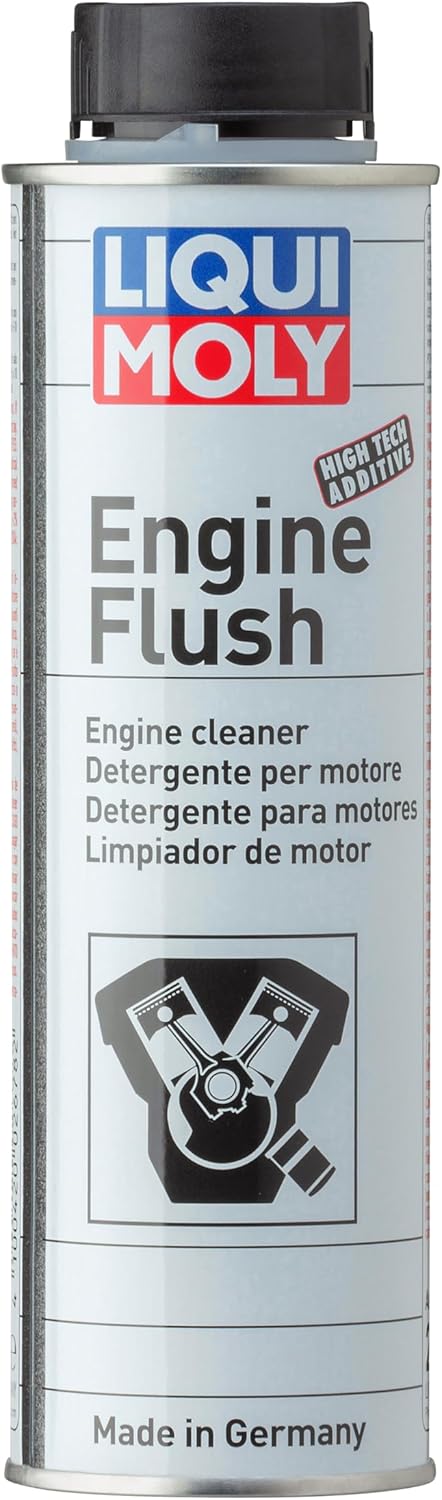
LIQUI MOLY ENGINE FLUSH — ENGINE CLEANING ADDITIVE (300 ML)
Professional additive Liqui Moly Engine Flush (SKU 2678) for internal engine cleaning before an oil change. Removes sludge, deposits, and residues that clog the oil vapor separator. Pour into old oil, run engine at idle for 10 minutes, then perform a normal oil and filter change. Costs less than 20€, can prevent interventions costing hundreds of euros.
🛒 Buy now on Amazon*Affiliate link: we may receive a small commission, at no additional cost to you.
🔍 Is your PureTech consuming oil? Ask us for a targeted diagnosis
With over 15 years of experience with Stellantis engines, at Autoricambi Tritella we help you identify the exact cause of oil consumption and choose the right spare parts: PSA B71 2312 approved oils, oil vapor separators, piston rings, overhaul kits. Authorized distributors of TotalEnergies, Castrol, Valvoline for Abruzzo, Marche, and Lazio.
📋 Request a free quote❓ FREQUENTLY ASKED QUESTIONS
Is it normal for the 1.2 PureTech to consume 1 liter of oil every 1,000 km?
No. The acceptable consumption threshold declared by Stellantis is a maximum of 0.5 L per 1,000 km. A consumption of 1 L/1,000 km is double the limit and indicates an ongoing technical problem: typically piston rings (2014-2018 turbo engines) or a faulty oil vapor separator (Euro 6.2 engines from 2018).
Can I continue driving by topping up the oil?
It is only a temporary solution, not recommended beyond 2-3,000 km. Continuing means exposing the engine to cumulative wear on bearings, crankshaft, turbo, and catalytic converter. The difference between a preventative intervention costing 200-300€ and a complete overhaul costing 4,000-5,000€ can be a few months of incorrect tolerance.
Does the problem resolve by changing the type of oil?
Only in early cases. An oil approved with PSA B71 2312 homologation (like Total Quartz INEO RCP 5W-30) and a reduced change interval to 10,000-12,000 km help with prevention and can slow down the phenomenon. If the segments are already worn or the separator is faulty, the correct oil is not enough: mechanical intervention is needed.
Does Stellantis reimburse expenses already incurred for oil consumption?
Yes, if you paid between January 1, 2022, and December 31, 2024. Go to stellantis-support.com and upload invoices, maintenance booklet, and technical diagnosis signed by an authorized workshop. Maximum tolerance of 3 months or 3,000 km delay in services. Reimbursements of approximately 170,000€ have already been issued across Europe.
How do I know what's affecting my PureTech?
Check the engine code under P5 of the registration document and the year of first registration. EB2DT/EB2DTS produced between Apr 2014 and Jul 2018 → piston rings. EB2ADTD/EB2ADTX produced between Feb 2018 and Feb 2023 → oil separator. An OBD-II diagnosis in a workshop confirms which fault is present by reading secondary codes (P0420, P0301-P0303, P0171, P2187).
How much does it cost to replace the oil vapor separator?
In an independent specialized workshop: 180-280€ for parts + labor. In the official Stellantis network: 280-450€. This is one of the more "economical" interventions on the PureTech and prevents more serious interventions on the pistons. If you have a Euro 6.2 (post-2018), it's the first part to check.
Does the Gen3 with chain also consume oil?
In very rare cases. The Gen3 (from 2023, codes EB2ADTS/EB2ADTD) has structurally resolved the oil-immersed timing belt issue and has a redesigned vapor separator. On these versions, anomalous oil consumption is rare and, when it occurs, is almost always related to extreme urban use or unapproved oils. However, the Gen3 has other active recalls (fuel 2025, MHEV March 2026): always check recalls via VIN.
Is it better to intervene immediately or wait?
Yes, intervene immediately. The longer you wait, the more costs increase: a preventative cleaning costs 90-140€, a separator 180-280€, piston rings 1,800-2,500€, a complete overhaul 3,500-5,000€, an engine replacement 6,000-10,000€. The progression of damage is exponential: the first 10,000 km of anomalous consumption cost little, the last 30,000 km cost an engine.
🏁 CONCLUSIONS
Excessive oil consumption in the 1.2 PureTech is not a minor nuisance: it is a structural warning sign officially recognized by Stellantis with reimbursement campaigns and an extended warranty of 10 years / 180,000 km. Ignoring it means accelerating towards an engine overhaul or a complete replacement with costs between 3,500€ and 10,000€.
The good news is that prevention works: PSA B71 2312 approved oil, reduced oil change intervals to 10-12,000 km, oil level check every 1,500 km, and annual OBD-II diagnostics are concrete levers that drastically reduce the risk. And if the problem is already occurring, activating the Stellantis extended warranty can eliminate the cost.
To delve into all other critical points of the engine, consult our complete guide to 1.2 PureTech problems, the focus on the oil-immersed timing belt (related to consumption) and the comparison between Gen1, Gen2, and Gen3.
✅ Everything you need for your PureTech
At Autoricambi Tritella you will find PSA B71 2312 approved oils Total Quartz INEO RCP 5W-30, Liqui Moly engine cleaning additives, oil vapor separators, piston ring kits and compatible spare parts from Bosch, Valeo, NGK for all models with 1.2 PureTech engine.
🛒 Visit the Tritella Shop


