

Home › Vehicle Issues and Failures › BMW N47 Engine › 1 Series E87
BMW 1 SERIES E87/E81 WITH N47 ENGINE: SPECIFIC PROBLEMS, MAINTENANCE, AND REAL COSTS
Updated April 2026 – Technical analysis based on real workshop cases.
The BMW 1 Series E87 with the N47 engine is the most compact and accessible version of the BMW diesel range featuring this powerplant. As a 5-door (E87) or 3-door (E81) hatchback, produced between 2004 and 2013, it remains one of the most popular used BMWs in Italy for those seeking an engaging drive, compact dimensions, and reasonable fuel consumption in an urban format.
It shares the same N47 engine problems—chain, EGR, DPF, oil—with the 3 Series E90, but it has its own characteristics related to its compact body, its predominantly urban intended use, and a used car market with lower prices that often attract buyers less attentive to maintenance. This guide analyzes the specific points of the E87/N47 combination that you won't find in previous articles.
Read also: BMW N47 ENGINE: COMPLETE GUIDE, PROBLEMS AND RELIABILITY
📋 1. MODEL OVERVIEW: E87/E81 VERSIONS WITH N47
| Body Type | Code | Production Years | Main N47 Versions |
|---|---|---|---|
| Hatchback 5-door | E87 | 2004–2011 | 116d, 118d, 120d, 123d |
| Hatchback 3-door | E81 | 2007–2012 | 116d, 118d, 120d |
| Coupe | E82 | 2007–2013 | 120d, 123d — less common |
| Convertible | E88 | 2008–2014 | Rarely diesel |
The most common versions in Italy are the 118d E87 (143 HP) and the 120d E87 (163 HP). The 118d is the most economical choice to buy and maintain—lower road tax in some regions, lower insurance costs. The 120d offers more driving pleasure with fuel consumption not very different in real-world use.
LCI (2007 restyling) — the preferred version
In 2007, the 1 Series E87 received the LCI restyling with redesigned headlights, updated interiors and—above all—the introduction of the N47 engine, replacing the old M47. The first diesel E87s (2004–2007) were fitted with the M47—an excellent, robust engine without the flywheel-side chain problem. From 2007 onwards, the N47 arrived. If you are considering a diesel E87 produced before 2007, you probably won't have the N47 chain issue—check the engine code on the registration document before worrying.
💡 How to identify M47 vs N47: On the vehicle registration document, the "engine type" field shows the code. M47 = 320d/120d/118d versions produced until approximately 2007. N47 = from 2007 onwards with the code N47D20. Alternatively, the VIN contains the engine identification code in position 5—a BMW mechanic can read it in 30 seconds.
⛓️ 2. N47 ENGINE IN THE E87: COMBINATION SPECIFICS
The N47 engine in the E87 is the same as that fitted in the 3 Series E90—same problems, same maintenance logic, same oil specifications. However, there are two specific aspects of the E87/N47 combination worth highlighting.
Chain accessibility: slightly more complex than the E90
The E87 engine bay is more compact than that of the E90 sedan. This does not change the procedure for accessing the chain—which is always on the flywheel side—but it can slightly increase the time required to dismantle the interface components. The labor difference compared to an E90 is typically 1–2 hours: in practical terms, an extra 80–150€ on the final quote. It's not a substantial difference, but it's worth knowing when getting a quote.
The E87 and the chain risk on early series
First-series E87s with the N47 (2007–2010, N47D20A) are exposed to the same risk as E90s from the same period. With an aggravating factor: the E87 has been and still is primarily used in the city—the worst use context for the EGR/DPF/oil cycle that we described in SAT-006. An E87 118d purchased as a city car with 120,000 km almost certainly has a worse oil wear profile than an E90 320d used for mixed driving with the same mileage.
For all technical details on the engine: BMW N47: TIMING CHAIN – WHY IT BREAKS, SYMPTOMS, AND REAL COSTS
🏙️ 3. THE PROBLEM OF INTENSIVE URBAN USE ON THE 1 SERIES
The 1 Series E87 is structurally a city car—compact dimensions, small turning radius, easy parking. The problem is that the N47 engine, like all modern diesels with DPF, suffers in intensive urban use much more than in mixed or extra-urban use.
The specific risk profile of the urban E87
An E87 118d used almost exclusively in the city with average trips under 15 km accumulates these risks at an accelerated rate compared to the same car used in a mixed environment:
- DPF: incomplete regenerations → progressive clogging as early as 60,000–80,000 km
- EGR: low operating temperatures → faster carbon deposits → cleaning required every 40,000–50,000 km instead of 60,000–80,000
- Oil: fuel dilution from DPF regenerations + Longlife service intervals to the limit → reduced real viscosity → accelerated stress on the chain tensioner
- Actual oil change: many E87 "city car" owners perform servicing every 20,000–25,000 km because "the computer doesn't ask for it sooner" — on this specific engine, this is an error that costs you on the chain
🚨 The paradox of the city E87: the ideal car for the city is the most unfavorable use context for its diesel engine. Those who buy an E87 N47 for urban use must accept tighter maintenance intervals than the manual suggests, or choose a petrol version. There is no middle ground that doesn't have hidden costs.
🔄 4. MANUAL AND AUTOMATIC GEARBOX ON THE E87
Manual gearbox — robust but with a critical point on the E87
The E87's manual gearbox is the same GS6 as in the E90 — solid and long-lasting. However, on this body style, the problem of premature clutch wear is more common due to urban use: continuous starts from standstill, slow maneuvers, traffic jams. A clutch on an E87 with predominantly urban use may require replacement as early as 80,000–100,000 km instead of the 150,000–180,000 km typical of mixed use.
The classic symptom: slipping on uphill slopes with a load, or the need to lift the foot far off the clutch to engage the gear. Replacing the clutch + dual-mass flywheel together (never just one of the two) costs 700–1,100€.
Automatic gearbox — less common on the E87
Automatic E87s are fitted with the same ZF 6HP as the E90 — the same considerations apply regarding gearbox oil maintenance every 60,000 km. Automatics are less common in the 1 Series compared to the 3 Series, but if you are considering an automatic E87 for urban use, it is paradoxically the more logical choice: no clutch problems and less mechanical stress in the city compared to the manual.
🛞 5. SUSPENSION: COMPACT DOESN'T MEAN SIMPLE
The E87's suspension is of the sports type—MacPherson at the front, multi-link at the rear—identical in philosophy to that of the E90 but calibrated for a lighter and more compact car. The components that wear out first are the same, but the frequency can vary based on intensive urban use.
Front
- Wishbone silent blocks — as on the E90, these are the first to fail. On a city E87 with many potholes and slow maneuvers, they can wear out even before 100,000 km. Symptom: imprecise braking, pulling to one side.
- Anti-roll bar bushes — "clunking" noise over bumps at low speed. An inexpensive fix (60–120€) often overlooked.
- Front shock absorbers — on E87s used in the city with many potholes, actual useful life of 70,000–90,000 km. Replacement in pairs: 350–550€.
Rear — the E87's specific critical point
The E87's multi-link rear axle is sophisticated but has one component that causes more problems than on the E90: the driveshaft support bearing (thrust arm bearing). On cars with intensive urban use and many direction changes, this component can fail within 100,000–130,000 km, producing a dull noise and instability at medium speeds. The intervention is not expensive (150–250€) but is often not diagnosed on the first attempt because the noise can be confused with shock absorbers or suspension issues.
🖥️ 6. ELECTRONICS AND COMFORT: THE LIMITATIONS OF THE E87
The E87 does not have the E90's iDrive in its basic versions — it features a simpler infotainment system, with radio/CD and an optional separate cassette-based navigation system. This paradoxically makes it more reliable on the electronic front than the first-generation iDrive E90.
Frequent electronic problems on the E87
- Slow or stuck electric windows — a known problem on E87s up to 2009. The regulators are the component to replace (80–150€ per door). Before replacing, check that the window channels are clean and lubricated — often the blockage is mechanical, not electrical.
- Intermittent central locking — the vacuum pumps of the locks wear out over time. Symptom: doors that don't click shut uniformly. Component cost: 80–150€.
- Check engine light for oxygen/lambda sensors — frequent on E87s with intensive urban use. Lambda sensors often get dirty more quickly due to less efficient combustion in the city. Sensor replacement: 100–200€.
- Battery drains when the car is stationary — as on the E90, parasitic draws from electronic modules. Test the quiescent current before replacing the battery.
Comfort: limitations that must be accepted
The E87 is a compact sports car — it was not designed for maximum acoustic comfort or long journeys. The noise level at motorway speeds is higher than the E90, thermal insulation is inferior, and rear space is limited. None of these are flaws to be repaired — they are characteristics of the format. If you are mainly looking for a car to travel 50,000 km a year on the motorway, the E87 is not the right choice. For those who use the car mainly in the city and on weekends, it is perfect.
🔍 7. BODYWORK: SPECIFIC CRITICAL POINTS OF THE E87
Rust spots to inspect
- Lower edge of the doors — E87s tend to accumulate moisture in the lower channel of the doors. Check with a flashlight along the entire length of the lower edge, especially at the corners.
- Front inner wheel arches — remove the inner fender (plastic) if accessible and check the sheet metal underneath. This spot is prone to rust on cars not regularly washed or used with winter road salt.
- Rear window — the rear window seals deteriorate and allow water to leak into the boot. Check for moisture in the boot and under the mat.
Bumpers and exterior plastics
E87s used in the city inevitably accumulate scratches and dents on the bumpers, especially the lower front one. This is not a mechanical problem, but it affects the value and presentation. On cars purchased from private sellers, poorly repainted bumpers can hide more serious structural damage — always check the color continuity with glancing light.
💰 8. REAL RUNNING COSTS
| Intervention | Frequency (urban use) | Estimated Cost |
|---|---|---|
| Oil + filter change (LL-04) | Every 7,000–8,000 km (urban use) | 80–130 € |
| Full service | Every 20,000 km | 180–300 € |
| Complete chain kit (preventive) | Once — over 120,000 km | 950–1,500 € |
| EGR cleaning | Every 40,000–50,000 km (urban use) | 100–200 € |
| DPF regeneration / cleaning | Variable — more frequent in urban use | 80–300 € |
| Clutch + dual-mass flywheel | Every 80,000–120,000 km (urban use) | 700–1,100 € |
| Front silent blocks | Every 90,000–120,000 km | 150–280 € |
| Shock absorbers (per axle) | Every 70,000–90,000 km (urban use) | 350–550 € |
| Brake pads + discs (per axle) | Every 30,000–50,000 km (urban use) | 180–380 € |
💡 Comparison with the E90: the running costs of the E87 N47 in urban use are on average 15–20% higher than the E90 in mixed use — due to tighter intervals for oil, EGR, and clutch. However, the E87 is significantly cheaper to buy (2,000–4,000€ difference for comparable cars). The overall balance in the medium term depends on how you use it.
✅ 9. E87 N47 USED CAR CHECKLIST
For the complete checklist on the N47 engine—cold start, OBD reading, oil, EGR/DPF—please refer to the dedicated guide: USED BMW N47: COMPLETE WORKSHOP CHECKLIST. Here are the specific checks for the E87.
- ☐ Check engine code on registration document — confirm it's N47 and not M47 (E87 diesel pre-2007 have M47, without the flywheel-side chain issue)
- ☐ Declared type of use — an E87 mainly used in urban settings will have EGR and DPF in worse condition than one used in mixed conditions, for the same mileage. Ask explicitly.
- ☐ Clutch condition — uphill start with load, uphill reverse. Slippage = clutch needs replacement (700–1,100€)
- ☐ All power windows — open and close each window. On E87s up to 2009, they are a known weak point.
- ☐ Uniform central locking — test from outside with remote and from inside with the central button
- ☐ Lower door edge — inspect with a flashlight, it's the first point of rust on the E87
- ☐ Dry trunk — remove the mat and check for moisture. Infiltration from the rear window or roof drainage channels.
- ☐ Rear noise at low speed over bumps — worn thrust arm bearing produces a dull thud difficult to locate. Test over slow bumps.
- ☐ Front silent blocks — hard braking on a straight line: the car must go straight without pulling
- ☐ Lambda / oxygen light on — worn lambda sensors are common on urban E87s. Read OBD codes before buying.
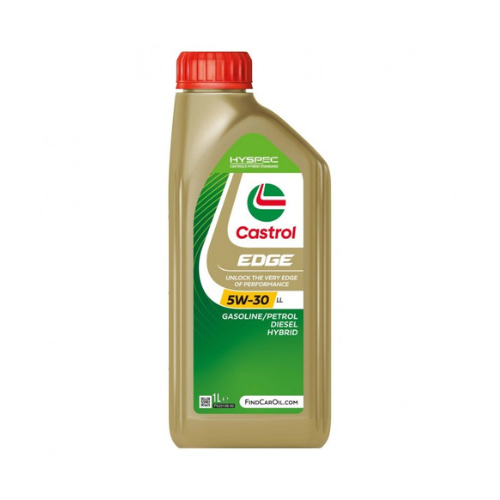
CASTROL EDGE 5W-30 – BMW LL-04 SPECIFICATION FOR E87 N47
For an E87 N47 with urban use, an oil change with LL-04 every 7,000–8,000 km is the most important preventive measure available. Castrol EDGE 5W-30 with BMW Longlife-04 approval is available in the Autoricambi Tritella catalog with fast shipping.
🛒 Buy on Autoricambi Tritella❓ FREQUENTLY ASKED QUESTIONS
Is the 116d or 118d E87 better?
The 116d uses the N47D16 engine (1.6d, 115 HP) — a different engine from the N47D20 of the 118d and 120d. The flywheel-side chain problem also exists on the N47D16, but documented cases are fewer due to its lower prevalence. From a practical standpoint, the 118d is preferable: more torque, same efficiency in real-world use, larger used car market with more mechanics familiar with it.
Is the E87 with the M47 engine (pre-2007) better than the N47?
Regarding only the chain issue, yes — the M47 has front timing and does not have the documented N47 problem. It is a robust and long-lasting engine. The disadvantage is that it is older (E87 diesel versions with M47 are at least 17–18 years old), fuel consumption is slightly higher, and emission after-treatment systems are less advanced. If the budget is low and the priority is mechanical reliability without surprises, a well-maintained M47 E87 is not a bad choice.
Does the E87 N47 have the same cold noise problem as the E90?
Yes, identical — same engine, same mechanism. The difference is that on the E87 the noise is slightly more perceptible from the outside because the engine bay is more compact and less soundproofed. If you have doubts, apply the same test described in SAT-002: open the hood with a cold engine and listen for the first 15–20 seconds after starting.
Is it worth buying an E87 N47 with 180,000 km?
It can be worth it if: the price is right, the chain replacement is documented, the oil history is verifiable, and there are no critical DTC codes. The advantage of the E87 compared to the E90 with the same mileage is the much lower purchase price — often a 2,000–3,000€ difference. With a preventive chain kit already done and maintenance up to date, an E87 N47 at 180,000 km still has many years ahead of it.
Where can I find a specialized BMW mechanic for the E87 in Italy?
The 1 Series E87 is very common — almost all specialized BMW mechanics know it well. Look for independent BMW specialized workshops in your area with verified reviews: the selection criteria are always the same, regardless of the model — documented experience with the N47, specific BMW tools, adaptive phase diagnostics. For spare parts and oil, Autoricambi Tritella ships throughout Italy.
📌 CONCLUSION
The BMW 1 Series E87 with N47 engine is a car that rewards those who choose it consciously and manage it carefully. Compact dimensions, engaging driving, low purchase costs — with a maintenance profile that requires more discipline than the segment average, especially in intense urban use.
Whoever acquires an E87 N47 knowing that they will need to change the oil every 7,000–8,000 km, take a weekly extra-urban trip for the DPF, and plan for the chain replacement beyond 120,000 km, has all the tools to keep this car in excellent condition for years. Those who treat it like any other car will encounter the surprises the engine reserves for those unfamiliar with it.
For BMW LL-04 oil, EGR/DPF additives, and spare parts for your BMW 1 Series E87, visit the Autoricambi Tritella catalog.


