

Home › Car Component Guide › Volkswagen and Audi EPC Light
VOLKSWAGEN AND AUDI EPC LIGHT: REAL CAUSES, DTC CODES, AND SOLUTIONS
Updated 2026 – Technical guide for Golf 8, Polo, Tiguan, Audi A3, and all VAG group models with EPC system.
Quick Answer
The EPC light (Electronic Power Control) on Volkswagen and Audi indicates a malfunction in the electronic power control system, which includes the throttle body, accelerator pedal sensor, brake switch, or ABS sensors. The most common causes are a blown brake light bulb (€5-20), a degraded 12V battery (€200-350), a dirty throttle body (€80-150 cleaning), or a faulty brake pedal switch (€60-120). On Golf 8 mild-hybrid models, 30-40% of cases are related to the 12V battery. Most common DTC codes: P0571, P0638, P1540, P1296. OBD diagnosis is mandatory before any replacement.
The EPC light (Electronic Power Control) illuminating on a Volkswagen, Audi, Seat, or Skoda is one of the most frequent error messages on these models—and one of the most confusing. It is not a generic "engine malfunction" light; EPC specifically indicates a problem in the electronic power control system, which includes the throttle body, accelerator pedal sensor, brake sensor, and traction control. A reset without diagnosis rarely provides a permanent solution.
Read also: VOLKSWAGEN GOLF 8: PROBLEMS, DEFECTS, AND FAULTS – COMPLETE GUIDE
🔍 1. WHAT DOES THE EPC LIGHT REALLY MEAN?
The EPC (Electronic Power Control) system manages everything related to the electronic regulation of engine power in VAG group vehicles—Volkswagen, Audi, Seat, Skoda. It includes:
- Electronic throttle body (drive-by-wire, no mechanical cable between pedal and throttle since about 2002)
- Accelerator pedal position sensor (with dual track for safety)
- Brake pedal sensor / switch
- Traction control system (ASR) and anti-slip regulation
- Cruise control (including adaptive ACC on recent models)
When the EPC light illuminates—either alone or with the engine light—the system has detected an anomaly in one of these components. In many cases, the car enters limp mode with reduced power to protect the engine, limiting revs to 2,500-3,000 and top speed to 60-80 km/h.
EPC light alone or accompanied by other lights: what changes?
- EPC light only—anomaly in the EPC system but without related engine codes. Often a less severe cause: brake sensor, fuse, minor electrical problem
- EPC + yellow engine light—more significant problem involving engine management. Urgent OBD diagnosis within 100-200 km
- EPC + red engine light—stop immediately. Serious problem that can cause damage to the engine or injectors if you continue driving
- EPC + ABS/ESP light—anomaly in wheel sensor or ABS module. Active safety is compromised
⚠️ 2. WHAT ARE THE MOST FREQUENT CAUSES BY MODEL?
| Cause | Additional Symptoms | Most Affected Models | Urgency |
|---|---|---|---|
| Dirty or faulty throttle body | Unstable engine idle, delayed accelerator response | Golf 7/8, Polo, Tiguan | Medium |
| Accelerator pedal sensor | Erratic acceleration, limp mode | All VAG models | Medium |
| Brake pedal sensor / switch | Brake lights always on or never on, cruise control disengages | Golf 7/8, Audi A3/A4 | High — safety |
| Blown brake light bulb | Only EPC light, no other symptoms | All VAG models | Low — check immediately |
| ABS wheel sensor | ABS light on together with EPC | All VAG models | High — active safety |
| Discharged or degraded 12V battery | Multiple warning lights, EPC disappearing after restart | Golf 8 eTSI, all early series 2020-2022 | Medium |
| Fuel pump or fuel pressure | Difficulty starting, sudden power drops | Models with TSI/TFSI turbo petrol engines | Medium |
| Ignition coil or spark plugs | Misfire (P0301-P0304), engine backfiring, vibrations | All VAG petrol engines, typical over 80,000 km | Medium |
| Loose contacts / oxidized connectors | Intermittent EPC, worsens with humidity or rain | Cars over 100,000 km, exposed to road salt | Low |
💡 The quickest check to do before going to the workshop: check the rear brake lights. Ask someone to look from outside while you press the brake pedal with the engine running. If one or both brake lights do not illuminate, you have found the cause—blown bulb or faulty brake pedal switch. It costs €5-20 and takes 10 minutes to fix. In a workshop, this check resolves 15-20% of EPC cases without expensive interventions.
📋 3. WHAT ARE THE MOST COMMON EPC DTC CODES?
| DTC Code | Description | Frequent Cause |
|---|---|---|
| P0120 / P0121 | Throttle position sensor / accelerator pedal out of range | Faulty accelerator pedal sensor |
| P1540 | EPC system — general malfunction | Throttle body or pedal sensor |
| P0571 | Brake pedal switch — circuit A | Faulty brake switch or blown bulb |
| P0638 | Throttle actuator — range/performance | Dirty or faulty throttle body |
| P1296 | Communication between accelerator pedal and engine control unit | Pedal wiring or control unit |
| C0031 / C0034 | Right/left front wheel speed sensor | ABS sensor — EPC activated by ASR module |
| P0301-P0304 | Cylinder 1/2/3/4 misfire | Coils, spark plugs or injectors — EPC as a secondary effect |
| U0100 / U0073 | CAN-bus communication errors | Typical from unstable 12V battery |
🚗 4. WHY IS THE EPC LIGHT FREQUENT ON THE GOLF 8?
The Golf 8 has some specific EPC causes related to its more advanced electronic architecture compared to previous generations.
EPC from a discharged 12V battery: the most frequent case on the Golf 8
The Golf 8—especially the eTSI mild-hybrid versions from the early 2020-2022 series—has had a documented problem of abnormal 12V battery drain during parking. A partially discharged battery generates unstable voltages (below 12.4V at rest) which cause the EPC system sensors to malfunction, producing false alarms. The EPC light appears at startup and disappears after a few seconds or after restarting.
If the behavior is intermittent and coincides with prolonged stops (over 3-4 days of inactivity), have the 12V battery tested before any other diagnosis. On Golf 8 mild-hybrids, an EFB (Enhanced Flooded Battery) or AGM (Absorbent Glass Mat) battery is mandatory—never a traditional battery, because it cannot withstand the charge/discharge cycles of start&stop and regenerative braking.
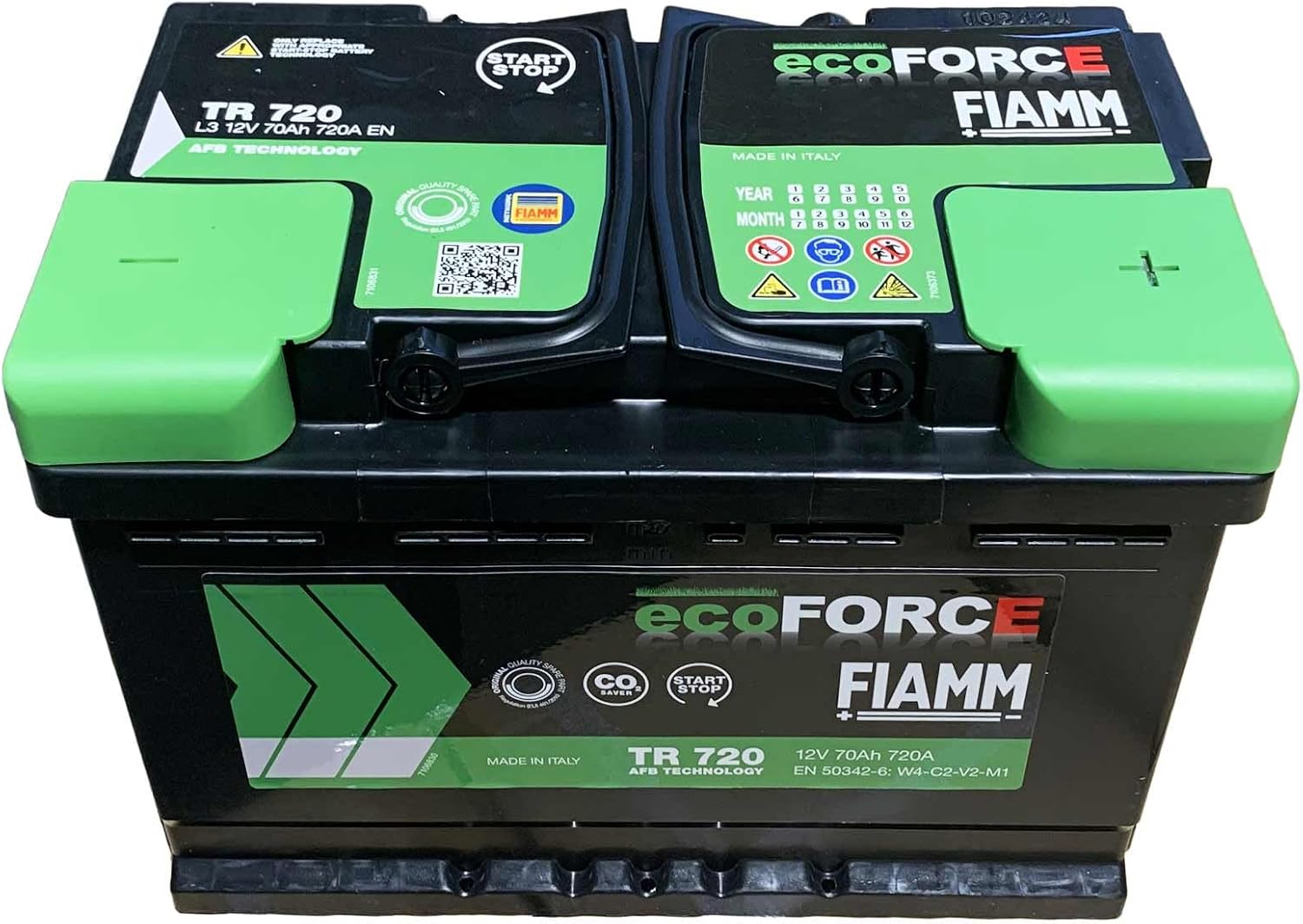
FIAMM TR720 ECOFORCE EFB 70AH 720A – START&STOP BATTERY
Fiamm EFB 70Ah / 720A battery with Enhanced Flooded Battery technology, compatible with start&stop and mild-hybrid systems of the VAG group (Golf 7/8, Polo, Tiguan, Audi A3, Seat Leon). It withstands intense charge/discharge cycles and prevents false EPC alarms from unstable voltage.
🛒 Buy now on Amazon*Amazon affiliate link: we may receive a small commission, at no additional cost to you. Always check compatibility with your car's manual before purchase.
EPC + ADAS lights on the Golf 8
On the Golf 8, the EPC may appear together with "ADAS unavailable" or "braking system unavailable" messages. In this case, there is almost always an anomaly in the ESP/ABS module that manages both traction control (part of the EPC system) and ADAS. OBD diagnosis on the ESP module is mandatory before any intervention.
EPC after battery replacement without coding
On the Golf 8, replacing the battery without performing battery coding (BEM – Battery Energy Management procedure) can generate a persistent EPC light. The energy management system does not recognize the new battery and mismanages current distribution to the sensors. Solution: battery coding with a VW-compatible tool (VCDS, ODIS, or equivalent). Intervention time: 5-10 minutes, workshop cost: €30-60.
For a complete guide to Golf 8 electronic problems: GOLF 8 — ELECTRONIC WARNING LIGHTS: DIAGNOSIS AND REMEDIES
🔄 5. WHEN DOES A RESET WORK AND WHEN NOT?
Resetting the EPC light—either via an OBD scanner or by disconnecting the battery—clears the error code from the control unit's memory, but does not solve the underlying problem that generated it. If the cause is still present, the light will come back on within a few kilometers or at the next startup.
When a reset truly solves the problem
- Transient error from unstable battery voltage—after charging or replacing the battery, a reset clears historical errors and the light does not return
- False alarm from a sensor that read an anomalous value only once—if the error is "historical" and not "active" in the OBD reading, a reset may be sufficient
- After correct repair—the reset is the final step after resolving the cause
- Loose contacts on sensor connectors (engine ground, ABS, brake)—cleaning + reset often resolves it permanently
When a reset is not enough
If the light returns within 200-500 km or at the next startup after a reset, the faulty component is still present and needs to be replaced. Continuously resetting without repairing solves nothing and can mask a problem that worsens over time, such as dripping injectors or an increasingly dirty throttle body.
DIY reset procedure (only as a temporary measure)
- Turn off the engine and ensure the car is stationary
- Disconnect the negative battery terminal
- Wait 10 minutes (not 5—more time is needed to fully discharge the control unit capacitors)
- Reconnect the battery and turn on the ignition without starting the engine for 30 seconds
- Start the engine and take a test drive of at least 10 minutes, including gentle accelerations and decelerations.
⚠️ Caution regarding reset on Golf 8: disconnecting the battery on the Golf 8 resets the battery coding and window regulator calibration. After reconnecting, you will need to perform the end-stop reset procedure for each window and, if the energy management system requires it, battery coding with a professional OBD tool.
Intermittent EPC: first try cleaning the electrical contacts
On cars over 100,000 km or exposed to road salt, a common cause of intermittent EPC is oxidized contacts or loose connections on sensor connectors (in particular, engine ground, ABS sensors, brake pedal switch). Before replacing components, try a thorough cleaning with a specific non-conductive cleaner: in the workshop, we see at least 10-15% of intermittent EPC cases resolved this way.

WD-40 SPECIALIST 39368 – ELECTRICAL CONTACT CLEANER 400 ML
Fast-drying electrical contact cleaner spray, non-conductive, NSF K2 certified. Removes oxidation, dirt, and residue from sensor connectors, control units, brake pedal contacts, and engine ground. Safe on plastics and rubber. Perfect for resolving intermittent EPC errors caused by loose connections.
🛒 Buy now on Autoricambi Tritella💰 6. HOW MUCH DO INTERVENTIONS COST IN 2026?
| Intervention | Indicative Cost | Notes |
|---|---|---|
| Brake light bulb replacement | €5–20 | First check to always perform — resolves 15-20% of EPC cases |
| Full OBD diagnosis (all modules) | €50–100 | Essential before any replacement |
| Throttle body cleaning | €80–150 | Before replacement — often sufficient |
| Electrical contact cleaning (DIY) | €10–20 | Resolves 10-15% of intermittent EPC cases |
| Brake pedal switch replacement | €60–120 | Inexpensive part, quick intervention (15-20 min) |
| Accelerator pedal sensor replacement | €150–300 | Often integrated into the pedal — the complete assembly is replaced |
| Throttle body replacement | €300–600 | Only if cleaning does not resolve the issue, it must be coded after installation |
| Wheel ABS sensor replacement | €100–250 | When EPC is caused by the ASR module |
| 12V EFB/AGM battery replacement + coding (Golf 8) | €200–350 | If the degraded battery is the cause of EPC errors |
| Coil + spark plug replacement (complete kit) | €200–400 | When EPC is caused by misfires (P0301-P0304) |
*Indicative prices May 2026, VAT included, workshop labor included. Variable based on area, model, and parts supplier.
💬 Do you have a quote from a workshop and want a second opinion?
Send us the diagnosis or quote you received, and we'll tell you if the prices are in line with the market. We'll help you find the right part for your VW or Audi (throttle body, ABS sensors, EFB/AGM batteries, coils, spark plugs) at the correct prices — often saving 20-30% compared to the dealership.
📩 Request a free quote🔗 7. RELATED INSIGHTS
The complete guide to Golf 8's critical issues: electronics, mild hybrid, software
→ Read more
All Golf 8 electronic warning lights and how to interpret them correctly
→ Read more
Batteries compatible with the entire VAG range: Golf, Polo, Tiguan, Audi A3
→ Go to Tritella catalog
❓ FREQUENTLY ASKED QUESTIONS
The EPC light turns on and then disappears on its own: should I be worried?
Yes — even if it disappears, the error is recorded in the control unit's memory as a "historical error." Take the car to a workshop for an error reading with an OBD scanner: you will find the DTC code even if the light is no longer on. An intermittent error is often a sign of a component progressively failing — it's better to intervene before it becomes a permanent fault. On Golf 8s, it's a classic symptom of a failing 12V battery.
Can I drive with the EPC light on?
It depends on the symptoms. If the light is on but the car is behaving normally — no power reduction, working brakes, regular acceleration — you can drive carefully to the workshop within 100-200 km. If the car is in limp mode (drastically reduced power, maximum rpm 2,500-3,000) or if the brakes seem less effective, stop as soon as possible. EPC accompanied by a red engine light: stop immediately.
Is the EPC light different from the engine light (check engine)?
Yes — they are different lights that refer to different systems. The engine light (check engine, engine icon) indicates problems in the emission system and overall engine management. The EPC light is specific to the electronic power control system — throttle body, accelerator pedal, brakes, traction. They can turn on together or separately, and the OBD reading will show different codes for each.
On which VW model is the EPC light most frequent?
It is common across the entire VAG range, but in the workshop, we see it most often on Golf 7 and Golf 8 (EPC system more integrated with ADAS), sixth-generation Polo, and third-generation Audi A3. On Golf 8, the first series from 2020-2022 had a higher frequency of false EPC alarms related to the 12V battery and outdated software — a problem largely resolved with subsequent firmware updates.
Can I reset the EPC light myself without an OBD scanner?
Yes, by disconnecting the negative battery terminal for 10 minutes, you can clear historical errors. But be careful on Golf 8: disconnecting the battery resets the battery coding and the window regulator end-stop calibration. Furthermore, if the cause of the fault is still present, the light will return within 200-500 km. A DIY reset is a temporary, not definitive, solution — if the light returns, an OBD diagnosis is needed.
How much does it cost to fix the EPC light in 2026?
It depends on the cause. The simplest cases (burnt brake bulb, flat 12V battery, loose connections) can be resolved for €5-20. Most cases (brake switch, accelerator sensor, throttle body cleaning) are resolved for between €60-300 including OBD diagnosis. More complex cases (new throttle body, EFB/AGM battery with coding, ABS sensors) rarely exceed €600. An OBD diagnosis at €50-100 is always the first step to avoid wasting money.
Can the EPC light cause engine power loss?
Yes, it is one of the most frequent symptoms. When the EPC system detects a significant anomaly, the engine ECU activates limp mode (emergency mode) as a protection: it limits RPM to 2,500-3,000, cuts turbo torque, and blocks maximum speed at 60-80 km/h. This is a normal safety behavior, not an additional fault. Once the EPC problem is resolved and reset, power returns to normal.
After changing the battery, the EPC light doesn't go away: what should I do?
On Golf 8 and across the entire recent VAG range, after battery replacement, BEM (Battery Energy Management) coding with a professional OBD tool like VCDS, ODIS, or equivalent is mandatory. Without this procedure, the system does not recognize the new battery and continues to generate EPC errors. Coding costs €30-60 in a workshop and takes 5-10 minutes.
📌 CONCLUSION
The EPC light on Volkswagen and Audi always requires an OBD diagnosis before any intervention — resetting without diagnosis does not resolve the underlying problem, it temporarily hides it. The simplest cases (burnt brake light bulb, flat 12V battery, loose connections) can be resolved with a few euros and a few minutes of work. More complex cases (throttle body, pedal sensor, ABS sensors) require specific components but rarely exceed €600.
The only wrong approach is to ignore the light or keep resetting it without finding the cause: the underlying problem worsens over time, and what costs €80 today may cost €400 tomorrow.
For electrical parts, EFB/AGM batteries, sensors, and specific diagnostics for Golf 8, Polo, Tiguan, and the entire VW/Audi range, visit the Autoricambi Tritella catalog or request a free quote.


4 comments
Aurelio
Ciao Ragazzi ho questo problema da diversi mesi, sono stato dal meccanico e mi ha cambiato il corpo farfallato ma il problema persiste.
Spesso mi si attiva in autostrada e quando si attiva l’EPC la macchina non va oltre i 2000 giri motore e 20 km. orari, molto pericoloso in autostrada, mi devo fermare per spegnere il motore e riavviare e poi si resetta ma ogni volta mi devo fermare.
Sapete darmi un parere?
Audu a3 g-tron benzina e metano. motore 1400 cc.
Domenico
Mi si accende la spia epc mentre guidavo, spengo la macchina, riaccendo non compare più, dopo si accende anche la spia della batteria, e la macchina non va più in moto.
Domenico
Mi si accende la spia epc mentre guidavo, spengo la macchina, riaccendo non compare più, dopo si accende anche la spia della batteria, e la macchina non va più in moto.
Rosario Scrofani
Molto esaustivi, grazie