

START-STOP SYSTEM FOR CARS – HOW IT WORKS, ADVANTAGES, DISADVANTAGES, AND THE RIGHT BATTERY
Start-Stop is a system that automatically turns off the engine during short stops (traffic jams, traffic lights, toll booths) and restarts it when the driver is ready to move off again. It was designed with a clear goal: to reduce fuel consumption and emissions in real-world traffic, where the engine remains running even when the car is stationary.
Today, almost all car manufacturers equip some type of start-stop system as standard: Mercedes-Benz, Peugeot, Citroën, Smart, Volvo, Land Rover, Volkswagen, Seat, Nissan, Fiat, BMW, Ford, Hyundai, Kia, Mazda, Toyota, Honda, Jaguar, Chevrolet, and many others. Over time, manufacturers (and suppliers like Bosch and Valeo ) have continuously updated the electronics to reduce the negative impact on the engine, starter motor, and battery .
In this guide we analyze in a simple but technical way:
- how the Start-Stop system really works;
- what are the real advantages in terms of consumption and emissions;
- the disadvantages for the engine, starter and battery;
- what type of battery is needed in a car with Start-Stop (AGM, EFB);
- when it is best to deactivate it and what mistakes to avoid in the workshop.

FIAMM VR760 ECOFORCE – 760A CAR BATTERY (MOD. 7903791)
High-performance car battery with 760A starting current and dimensions 278 × 176 × 190 mm . The Fiamm Ecoforce series guarantees reliable starting, greater resistance to vibration and long life, ideal for modern cars that require efficiency and stability.
🛒 Buy now on Amazon📋 ARTICLE INDEX
- 👉 What is the Start-Stop system and why was it introduced?
- 👉 How Start-Stop works in practice
- 👉 Advantages: consumption, emissions and engine components
- 👉 Disadvantages: battery, motor and driving comfort
- 👉 Which battery should I use on a car with Start-Stop (AGM vs. EFB)?
- 👉 When it makes sense to deactivate Start-Stop
- 👉 FAQ – Frequently asked questions about the Start-Stop system
- 👉 Conclusions and practical advice
✅ WHAT IS THE START-STOP SYSTEM AND WHY WAS IT INTRODUCED?
Traffic jams are a major problem in large cities: the engine runs for minutes, sometimes hours, even when stationary. The result:
- fuel consumption that increases without producing “useful kilometers”;
- increased emissions of CO₂ and pollutants (NOx, particulate matter);
- increased general wear of the engine and exhaust gas aftertreatment systems.
The purpose of the Start-Stop system is precisely to reduce this waste: when the vehicle is stationary and no power is needed at the wheels, the control unit turns off the engine and restarts it automatically when the driver wants to move off again.
⚙️ HOW THE START-STOP SYSTEM WORKS IN PRACTICE
The principle is simple, but behind it lies a rather complex electronic management. Under normal conditions:
- the driver stops (e.g. at a traffic light) with the gear engaged and the brake pedal pressed (or in neutral on a manual gearbox);
- the control unit checks some safety parameters : engine temperature, battery status, road slope, air conditioning use, etc.;
- If everything is OK, the system turns off the engine and keeps the electric power steering, lights, infotainment and climate control active (within certain limits).
When the driver wants to leave again:
- release the brake pedal (on automatic transmissions) or press the clutch (on manual transmissions);
- the control unit controls the reinforced starter motor or the reversible alternator;
- the engine restarts in a few tenths of a second and the car is ready to move.
To manage these continuous switching on and off you need:
- specific starter motors, designed for many more cycles than traditional ones;
- dedicated batteries (AGM or EFB) capable of withstanding deep discharges and rapid recharges;
- engine control units and body that communicate with each other with logic dedicated to fuel saving.
✅ ADVANTAGES OF THE START-STOP SYSTEM
💰 Fuel economy
Turning off the engine when it's not needed means cutting some of the fuel consumption while the engine is idling . The savings depend greatly on the type of route:
- extra-urban/motorway use → almost zero advantage;
- mixed use with moderate traffic → visible but limited savings;
- cities and frequent traffic jams → the savings can become significant in the long term .
🌍 Reduction of polluting emissions
Less idling time = less fuel burned. This translates to:
- less CO₂ emitted;
- reduction of harmful substances (especially in urban environments, where people are close to the drain);
- contribution to compliance with increasingly stringent Euro regulations .
🛠 Effects on the catalytic converter, spark plugs and EGR
An often overlooked benefit is the effect on the combustion and after-treatment system :
- By minimizing idling hours, you reduce the formation of carbon deposits on spark plugs;
- the catalyst works more efficiently because the engine spends less time in “dirty” conditions (rich mixture, low temperature);
- in diesel engines, it slows down the formation of deposits on the EGR valve and promotes more regular regeneration of the diesel particulate filter (DPF) ;
- In some cases, urea (AdBlue) consumption can also be slightly reduced, because the engine is run for less time in unfavorable situations.
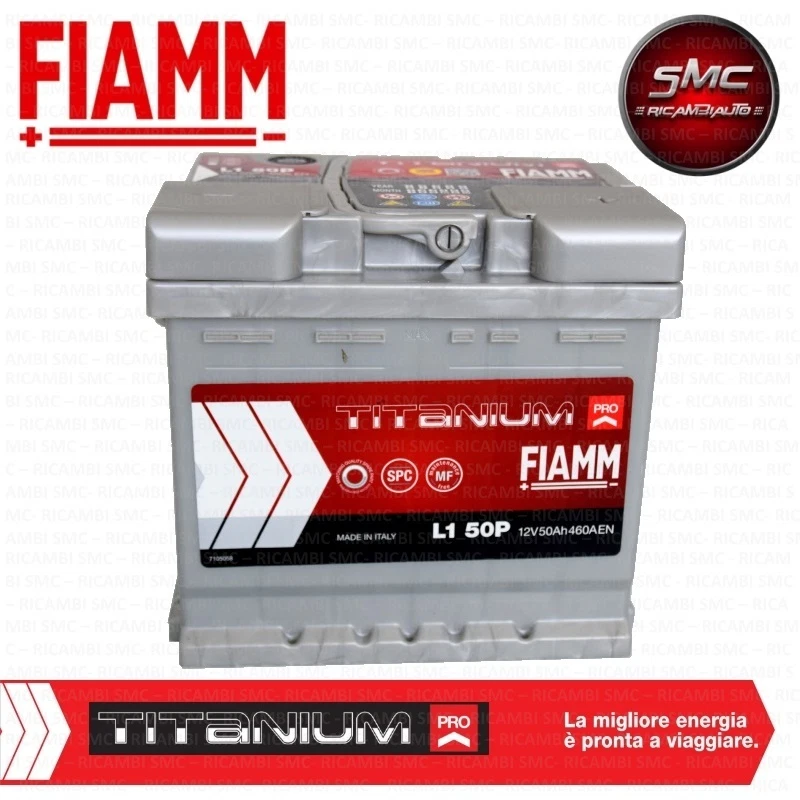
FIAMM 50Ah 460A L1 50P – CAR BATTERY (+DX) (COD. 7905143)
FIAMM 50Ah car battery with 460A starting current, positive pole on the right (+DX) and L1 50P format. Reliable, robust and ideal for small and medium-sized cars that require prompt and consistent starting.
🛒 Buy now on eBay⚠️ DISADVANTAGES OF THE START-STOP SYSTEM
🔋 Battery and motor more stressed
The downside is that Start-Stop requires more robust components :
- specific batteries (AGM or EFB) designed to withstand many more charge/discharge cycles;
- heavy-duty starter motors or reversible alternators capable of starting the engine hundreds of times a day.
These components cost more than traditional ones: often double . Furthermore, if you install the wrong battery (a traditional lead-acid instead of an EFB/AGM), it wears out quickly and causes problems such as Start-Stop shutdowns, difficult starting, and warning lights on the dashboard .
⚙️ Increased load on the crankshaft and bearings
With each start, the engine experiences a small mechanical shock. With Start-Stop, the number of starts increases significantly: theoretically, engines are sized to withstand it, but the load on the crankshaft bearings and other rotating parts still increases compared to a car without this system.
⏱ Driving comfort and delay in starting
Another point to consider is the slight delay in starting :
- Most modern systems restart the engine within a few tenths of a second, but a sensitive driver may still notice a small “hole”;
- In frequent maneuvers (parking, very close stop-and-go) some people prefer to temporarily deactivate the Start-Stop to have an immediate response.
🔋 WHICH BATTERY TO USE ON A START-STOP CAR (AGM VS EFB)
One of the most common mistakes we see in shops and workshops is replacing the Start-Stop battery with a traditional one to "save money." The car starts quickly, but after a few months, problems begin.
AGM (Absorbent Glass Mat)
- used mainly on cars with more advanced Start-Stop, many electrical systems and braking energy recovery systems;
- excellent resistance to deep discharges and frequent cycling;
- higher cost, but longer life if used correctly.
EFB (Enhanced Flooded Battery)
- intermediate solution between traditional and AGM batteries;
- widespread on many small cars and sedans with standard Start-Stop;
- good compromise between price and number of cycles supported.
✅ Rule of thumb: If the manufacturer recommends an AGM battery , it should be replaced with an AGM one. If it recommends an EFB battery, you can either stay on the EFB battery or upgrade to an AGM battery (never the other way around).
Additionally, on many modern cars it is necessary:
- register the new battery in the control unit via diagnostics;
- Check the condition of the charging system and wiring, not just “change the battery and go.”
2025 CAR BATTERY RANKING – AGM vs. AFB
Real differences between AGM and AFB/EFB batteries, advantages, effective lifespan, Start&Stop compatibility and an updated ranking of the best models in 2025. A clear technical guide to making the right choice.
📘 Read the complete guide⏸ WHEN IT MAKES SENSE TO DEACTIVATE START-STOP
Almost all cars allow you to temporarily disable Start-Stop via a button on the dashboard. This can be a good idea in some situations:
- repeated maneuvers in tight parking spaces;
- steep climbs or slope starts with heavy traffic;
- cases where the battery is already weak and you are waiting for a replacement.
However, we advise against permanent modifications (excluding software, jumpers, emulators): in addition to possible approval and warranty problems, the control unit could interpret incorrect data and generate errors on other connected systems.
❓ FAQ – FREQUENTLY ASKED QUESTIONS ABOUT THE START-STOP SYSTEM
Does Start-Stop damage the engine?
Engines designed to work with Start-Stop have bearings and lubrication suited to the highest number of starts. Under normal conditions, the engine doesn't "suffer" more than it should. Problems arise when the system is paired with the wrong batteries or routine maintenance is neglected.
How much fuel do you really save?
It depends a lot on the type of route. In cities with heavy traffic, the savings can be noticeable over the long term, while on extra-urban routes and motorways the effect is almost nil. The primary objective remains reducing emissions in an urban context .
Can I fit a normal battery to a car with Start-Stop?
Technically, the car could start, but this is not recommended . Traditional batteries are not designed for start-stop loads and wear out very quickly, risking constant problems when starting and stopping the system. It's best to always use AGM or EFB batteries, according to the manufacturer's specifications.
Why does the Start-Stop system sometimes not work?
Usually, the control unit blocks the system for safety reasons if certain conditions are not met: battery too low, cold engine, steep slope, air conditioning requiring a lot of power, doors not closed properly, etc. It's not necessarily a fault, but a technician can check with a diagnosis to see if any errors are stored.
✅ CONCLUSIONS AND PRACTICAL ADVICE
The Start-Stop system is a concrete answer to the problems of consumption and emissions in the city : if used correctly, it helps save fuel and pollute less, without significantly penalising the life of the engine.
On the other hand, however, it requires:
- dedicated batteries and starter motors , more expensive but designed for many more cycles;
- more careful maintenance, especially of the electrical system and charging system;
- make informed choices when replacing the battery (correct AGM/EFB, possible registration in the ECU).
If you are unsure about the right type of battery for your car with Start-Stop, or the system no longer works as it used to, you can contact us indicating the chassis number (VIN), make, model and year : we will help you identify the correct spare part and avoid unnecessary expenses.


