

Home › Vehicle Problems and Faults › Volkswagen Golf 8 › Oil and Coolant Leaks
VOLKSWAGEN GOLF 8: OIL AND COOLANT LEAKS – CAUSES, DIAGNOSIS, AND COSTS
Updated April 2026 – Specific technical analysis for Golf 8 1.5 TSI, eTSI, and 2.0 TDI based on real workshop cases.
Oil and coolant leaks on the Volkswagen Golf 8 are not all the same — the most frequent leak points vary depending on the engine, mileage, and maintenance history. A 1.5 TSI with 100,000 km will leak from different points than a 2.0 TDI with intensive urban use. In this guide, you will find specific causes for each engine, how to recognize the type of leak, what to check before going to the workshop, and the actual costs of repairs.
Read also: VOLKSWAGEN GOLF 8: PROBLEMS, DEFECTS AND FAULTS – COMPLETE GUIDE
🔍 1. HOW TO IDENTIFY THE TYPE OF LEAK
The first step is to identify what your Golf 8 is leaking. The color, consistency, and location of the stain under the car provide precise information even before opening the hood.
| Fluid | Typical color | Consistency | Odor | Urgency |
|---|---|---|---|---|
| Engine oil | Amber brown → black | Viscous, oily | Burning oil | Medium — don't postpone |
| Coolant | Pink (Golf 8 uses HT-12) | Fluid, watery | Sweetish | High — risk of overheating |
| DSG gearbox oil | Amber red/orange | Viscous, more fluid than engine oil | Transmission oil | Medium |
| Air conditioner water | Clear / colorless | Watery | None | None — it's normal |
💡 A drip under the car in summer is almost always air conditioner water — clear, odorless, located under the passenger side. It is normal air conditioner drainage and does not indicate any problem. If the stain is colored or oily, however, it needs to be checked.
💧 2. OIL LEAKS ON THE 1.5 TSI: MOST FREQUENT POINTS
The 1.5 TSI (EA211 EVO) engine of the Golf 8 has specific leak points that emerge progressively with mileage, almost always accelerated by incorrect oil specifications or excessively long service intervals.
Valve cover — the most common point
The upper valve cover gasket is the most frequent leak point on the 1.5 TSI over 80,000 km. It manifests as an oily stain on the top of the engine, a burning smell in the cabin (oil drips onto hot intake parts), and, in advanced cases, thin smoke from the engine bay after a journey. Gasket replacement: 120–200€ in an independent workshop.
PCV system — crankcase ventilation
The PCV (Positive Crankcase Ventilation) system of the 1.5 TSI is prone to oil clogging at high mileage, especially with urban use. When clogged, pressure in the crankcase increases and forces oil outwards through the gaskets — creating what looks like a gasket leak but is instead caused by excessive pressure. Symptoms: progressive oil consumption without obvious visible leak, slight whistling from the engine, bluish smoke. Cleaning or replacing the oil-vapor separator: 150–300€.
Turbo oil lines
The turbocharger oil supply and return lines can loosen or degrade after 100,000 km. Visible leak in the turbo area, on the side of the engine. If not addressed quickly, lack of lubrication to the turbo causes irreversible damage to the shaft. Cost of replacing lines: 80–200€. Cost of turbo replacement due to oil starvation damage: 1,200–2,000€.
Oil filter housing
The oil filter housing gasket can degrade — visible leak on the front side of the engine, below the filter. Often confused with an oil pan leak. Visual inspection with a flashlight immediately identifies the source. Gasket replacement: 60–120€.
💧 3. OIL LEAKS ON THE 2.0 TDI: SPECIFIC CAUSES
The Golf 8's 2.0 TDI has a different leak profile than the 1.5 TSI — more mechanically robust but with specific problems related to the emissions system and intensive urban use.
Oil dilution with diesel
This is not an external leak but is often mistaken for abnormal consumption: diesel fuel produced during frequent DPF regenerations mixes with the engine oil, lowering viscosity and increasing the dipstick level (oil rising above MAX instead of falling). On TDIs with predominant urban use and frequent DPF regeneration, the oil level rising instead of falling is a sign of dilution. The oil must be changed immediately in this case — it is no longer able to lubricate correctly.
Valve cover gasket
Same point as the TSI but more common on high-mileage TDIs. Characteristic burning smell, oily stain on the top of the engine.
Turbo leaks on high-performance TDIs
On the 2.0 GTD (DTUA, 147 kW), turbo leaks are more frequent than on standard TDIs due to higher operating temperatures. Periodic checking of turbo oil lines every 60,000 km is recommended.
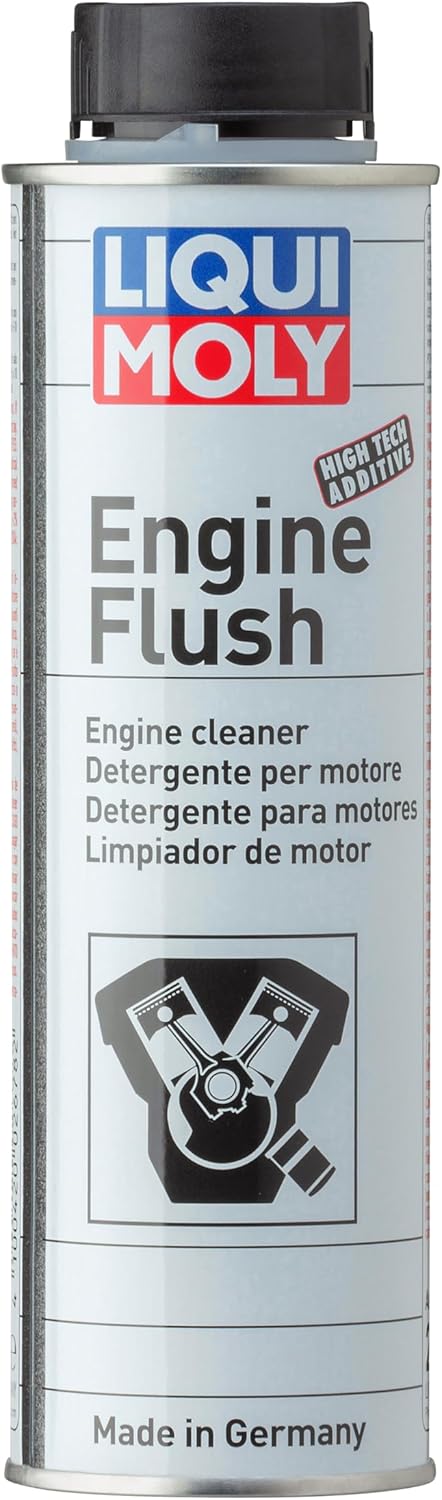
LIQUI MOLY ENGINE FLUSH – ENGINE CLEANING PRE-OIL CHANGE
On Golf 8s with high mileage and a history of not always correct oil, an Engine Flush treatment before an oil change removes sludge from the lubrication channels of the PCV, turbo, and lines — reducing the risk of deposits clogging passages after an oil change. Add to old oil 10 minutes before draining.
🛒 Buy on Amazon*Affiliate link: we may receive a small commission, at no additional cost to you.
📉 4. ABNORMAL OIL CONSUMPTION WITHOUT VISIBLE LEAK
A frequent case on the Golf 8 1.5 TSI: the oil level drops between services but there are no stains under the car and no visible leaks in the engine bay. This is not normal — a healthy engine should not consume oil between services.
Main causes
- Clogged PCV system — as described above, crankcase pressure forces oil vapors into the intake system. The oil is burned in the engine instead of leaking out — there is no visible leak but the level drops.
- Worn piston rings — on Golf 8s with over 150,000 km and a history of delayed oil changes. Bluish smoke from the exhaust, especially under acceleration. More expensive intervention: engine overhaul.
- Worn valve guides — similar to piston rings, bluish smoke especially on deceleration (throttle release).
- Incorrect oil specification — oil with viscosity too low (e.g., 0W-16 instead of the correct 0W-20) can lead to higher consumption in engines not calibrated for that viscosity.
⚠️ How much consumption is acceptable? Volkswagen indicates acceptable consumption up to 0.5 L per 1,000 km on the Golf 8. In practice, a healthy engine should not exceed 0.1–0.2 L/1,000 km. If you consume more than half a liter every 1,000 km, it's time for a specific diagnosis of the PCV system and piston rings.
🌡️ 5. COOLANT LEAKS: CAUSES AND URGENCY
Coolant leaks on the Golf 8 are rarer than oil leaks but have greater urgency — engine overheating can cause irreversible cylinder head damage in just a few minutes of driving.
Most frequent leak points
| Leak point | Symptoms | Urgency | Repair cost |
|---|---|---|---|
| Rubber hoses | Slow leak, sweetish smell | Medium | 60–150 € |
| Expansion tank | Dropping level, pink stains under hood | Medium | 80–180 € |
| Water pump | Leak in belt/chain area, pump noise | High | 250–500 € |
| Radiator | Frontal leak, progressive overheating | High | 300–600 € |
| Head gasket | Oil in water (brown), white exhaust smoke, rapid overheating | Very urgent — stop immediately | 1,000–2,500 € |
How to recognize a compromised head gasket
This is the most serious case and must be recognized immediately. Specific signs: coolant turning brown/milky (oil mixing), oil appearing frothy on the filler cap, dense and persistent white smoke from the exhaust (not normal morning vapor), rapid overheating even after a few km. If you have even two of these signs — stop immediately and call roadside assistance. Driving with a compromised head gasket can warp the cylinder head in minutes.
✅ 6. WHICH COOLANT DOES THE GOLF 8 USE?
This is a critical point that the original article got wrong: the Golf 8 does not use G12 or G13. It uses Valvoline HT-12 pink — a more recent specification indicated by Olyslager technical documentation for this generation.
| Engine | Correct fluid | Color | Replacement interval |
|---|---|---|---|
| All Golf 8 engines | Valvoline HT-12 Antifreeze Coolant Pink RTU | Pink | Check every 24 months / 30,000 km |
🚨 Do not top up with G12 or G13 green/blue. Mixing different types of fluids can cause precipitates and blockages in the cooling system. If you need to top up urgently and do not have the correct product, use only distilled water as a temporary measure — then take the car to a workshop for topping up with the correct product.
🛠️ 7. HOW TO PERFORM A CORRECT DIAGNOSIS
Before going to a workshop with an unidentified leak, these quick checks allow you to arrive with useful information that saves time and money.
Visual inspection with a flashlight (5 minutes)
- With the engine cold, open the hood and illuminate the top of the engine with a flashlight — look for oily traces on the valve cover
- Check the sides of the engine in the oil filter area and turbo connections
- Look under the compartment with a flashlight — the location of the stain approximately indicates the leak point
- Check the coolant reservoir cap — if the fluid is brown or frothy, serious cylinder head problem
- Check the oil cap — if it's white/frothy, coolant in the oil
Coolant pressure test
For slow or intermittent leaks not visible during visual inspection, a cooling system pressure test is the most effective diagnostic tool. The system is inflated with a special pump, and a pressure drop is checked. This also identifies internal leaks not visible externally.
💰 8. REPAIR COSTS
| Intervention | Engine | Estimated cost |
|---|---|---|
| Valve cover gasket | 1.5 TSI / 2.0 TDI | €120–220 |
| PCV separator cleaning / replacement | 1.5 TSI | €150–300 |
| Oil filter housing gasket | All | €60–120 |
| Turbo oil lines | 1.5 TSI / 2.0 TDI | €80–200 |
| Coolant hoses | All | €60–150 |
| Coolant expansion tank | All | €80–180 |
| Water pump | All | €250–500 |
| Radiator | All | €300–600 |
| Cylinder head gasket | All | €1,000–2,500 |
| Engine oil change 0W-20 (with correct specification) | 1.5 TSI / eTSI | €80–140 |
For the correct oil specification for each Golf 8 engine with capacity and intervals: GOLF 8 ENGINE OIL: WHICH TO USE FOR EACH ENGINE TYPE
❓ FREQUENTLY ASKED QUESTIONS
The oil level is rising instead of falling: is this a problem?
Yes — especially on the 2.0 TDI with intensive urban use. A rising level indicates oil dilution with diesel fuel produced by frequent DPF regenerations. Diluted oil does not lubricate correctly and must be changed immediately, regardless of the scheduled interval. If the level continues to rise after an oil change, the DPF requires a forced regeneration and the system must be checked.
Can I continue driving with a small oil leak?
It depends on the extent. A small stain under the car with a stable oil level (checked weekly) can wait a few days for diagnosis. If the level drops by more than half a liter in a week, or if you see smoke from the engine compartment, do not drive and have a workshop intervene. Oil starvation irreversibly damages the turbo in a few minutes.
What is the correct coolant for the Golf 8?
The Golf 8 uses Valvoline HT-12 Antifreeze Coolant Pink — not the green G12 or G13 mentioned in many generic articles. Using the wrong product or mixing different types can cause precipitation in the cooling system. If you urgently need to top up, only use distilled water as a temporary solution and take the car to a workshop for the correct product.
How to prevent oil leaks on the 1.5 TSI?
Three concrete actions: correct oil (0W-20 VW 508.00/509.00 — not the 5W-30 of the Golf 7), respected intervals (maximum 15,000 km or 12 months, reduced to 10,000 km with predominant urban use), Engine Flush before each oil change on cars with high mileage and uncertain maintenance history. These three actions together cover 90% of the leaks we see in the workshop on this engine.
📌 CONCLUSION
Oil and coolant leaks on the Volkswagen Golf 8 almost always have a specific and resolvable cause — valve cover, PCV, turbo fittings for oil; hoses and tank for coolant. The most effective prevention is the correct oil (0W-20, not the 5W-30 of the Golf 7) changed at the right time. Serious leaks like the head gasket are rare on a well-maintained Golf 8 — almost always a consequence of minor leaks ignored for too long.
For 0W-20 VW 508.00/509.00 engine oil and all products for Golf 8 maintenance, visit the Autoricambi Tritella catalog.


