

BEST ENGINE OIL ADDITIVES: WHICH ONES REALLY WORK AND WHEN TO USE THEM
In the workshop, the question always comes up when the engine has many kilometers: "It consumes a little oil", "it makes more noise when cold", "can I put an additive in it?". The problem is that there are exaggerated promises circulating on the market: it seems that a bottle can repair an engine. It doesn't work that way.
This guide is written for those who are wary of marketing and want a technical answer: what engine oil additives really do, which types work, when they make sense and when they are a waste of money. No miracles, no "repairs": just correct expectations and real cases.
📋 WHAT YOU'LL FIND IN THIS GUIDE
- 🔍 Why the question about additives is so confusing
- 🧪 What engine oil additives really are
- ⚙️ Types of additives (technical classification)
- ✅ Which ones really work (and why 2 are often enough)
- 🛠️ When to use an additive (real cases)
- ⛔ When NOT to use an additive
- ⚠️ Additives and oil: common mistakes
- 🔧 The workshop's point of view
- ❓ Frequently Asked Questions
- 🏁 Technical Conclusion
Why the question about additives is so confusing
Because three things that shouldn't be in the same pot are mixed: aggressive marketing, real mechanical problems, and oil chemistry.
- Aggressive marketing: "regenerates," "repairs," "restores compression." Words that create the wrong expectation: an additive does not rebuild rings, does not fix bearings, does not eliminate mechanical play.
- Unrealistic promises: many look for additives when the engine already has a serious problem (significant smoke, high consumption, low oil pressure, knocking). In that case, it becomes a "last resort."
- Lack of technical distinction: "oil additive" means nothing if you don't state its function: anti-friction, detergent, anti-wear/anti-consumption. If you choose the wrong category, you get the wrong result.
So: the right question isn't "which is the best overall?", but which type is right for my case and what realistic result can I expect.
What engine oil additives really are
A modern oil is already formulated with additives: detergents, dispersants, anti-wear agents, antioxidants, anti-corrosion agents, friction modifiers. An aftermarket additive is a targeted reinforcement of one (or more) oil functions, not a "repair kit".
What they can (really) do:
- Reduce friction in certain conditions (especially under boundary lubrication: startup, load, heat)
- Help manage light deposits if used judiciously
- Stabilize the oil film and help in cases of moderate (not pathological) consumption
What they CANNOT do:
- Repair wear or mechanical damage (rings, cylinders, turbo, valve guides, bearings)
- Eliminate metallic knocking or solve low oil pressure
- Replace maintenance and diagnostics (correct oil, filter, intervals, checks)
Practical workshop rule: an additive can help a "tired but healthy" engine. If the problem is mechanical, a bottle won't solve it.
Types of engine oil additives (TECHNICAL CLASSIFICATION)
Anti-friction additives
Operating principle: they improve protection under boundary lubrication, reducing friction and micro-wear. This category, when relevant, yields the most noticeable results: smoothness, slight noise reduction, protection under load.
When they can help:
- Engines with high mileage but no serious symptoms
- Slight noise (ticking that diminishes when warm)
- Heavy use (urban, many starts, intense heat, loads)
Real limitations: if there's metallic knocking, oil pressure warning light, constant "dry" noise, the additive is not the solution: diagnosis is needed.
Detergent additives
What they actually clean: light residues and deposits, not significant buildup. They can be useful for "maintenance" on engines that are well-serviced.
Risks on old engines: if the engine is full of sludge, a detergent can dislodge material that ends up circulating (filter getting clogged, delicate oil passages suffering). It's not magic: it's physics and dirt.
When to avoid them:
- Engines with uncertain maintenance history and obvious sludge
- Engines with abnormal symptoms (fluctuating oil pressure, sudden noises)
- When trying to "make up for years" all at once
Anti-wear / anti-consumption additives
Realistic cases: moderate oil consumption and an engine that, for the rest, runs smoothly (no significant constant smoke, no obvious leaks, no severe symptoms).
Correct expectations: they can help slightly reduce consumption and improve protection. They do not eliminate high consumption due to worn rings, leaking turbos, or valve guides.
Which engine oil additives really work (and why 2 are often enough)
After years of real-world feedback, the technical conclusion is simple: the types that yield the most consistent and repeatable results are two:
- Anti-friction (preferably with "stable" technology over time): they help with slight noise and protection under load, without telling fairy tales.
- "Balanced" anti-wear: useful as support for engines with medium-high mileage and daily use, with realistic expectations.
For this reason, when a customer asks us "give me a concrete reference," instead of an endless list, we point to two representative products from these categories. Not because "the others never work," but because these two cover the only avenues that, in practice, make sense for most "normal" cases.
Ceramic anti-friction additive: when it's really needed
Anti-friction additives are the ones that, absolutely, have the most measurable results in the field: reduction of internal friction, greater smoothness, attenuation of slight noise. Among these, "ceramic" technology is often chosen because it aims at surface protection without promising impossible repairs.
Realistic result: It can help with slight noise and protection under load/temperature conditions, especially on high-mileage engines. It does not repair worn components.

LIQUI MOLY CERA TEC 3721 – CERAMIC ENGINE OIL ADDITIVE (300 ML)
Liqui Moly Cera Tec ceramic additive for petrol and diesel engines. Reduces internal friction, improves smooth running, and helps to reduce consumption and wear. Long-lasting protection of mechanical components even under high load conditions.
🛒 Buy now on AmazonTraditional anti-wear additive: lubrication support
Classic anti-wear additives don't perform miracles, but they can help improve oil film protection and smooth operation in used engines, if used as a maintenance treatment and not as a "last hope."
Realistic result: It can help reduce friction/wear and improve regularity in daily use. It does not eliminate failures or significant consumption due to mechanical causes.
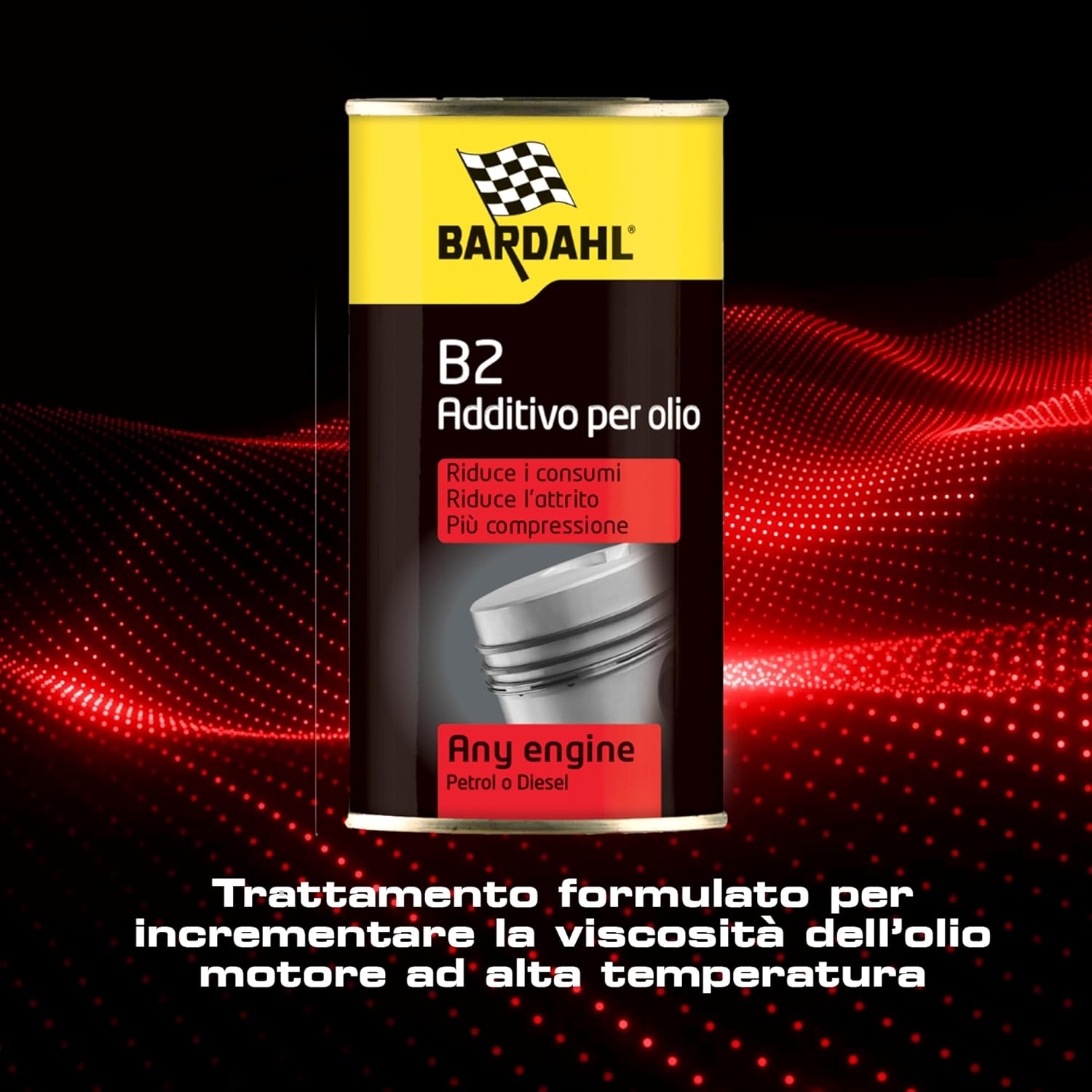
BARDAHL B2 – ENGINE OIL ADDITIVE (300 ML)
Bardahl B2 oil additive suitable for all petrol and diesel engines. Improves engine performance, reduces friction and wear, and contributes to greater protection of mechanical parts. Ideal as a periodic treatment to keep the engine efficient and smooth.
🛒 Buy now on AmazonImportant technical note: these two additives are practical references because they well represent two functional categories with consistent results. To be clear: they can help in the right context, but they do not solve mechanical failures or serious situations.
When to use an additive (REAL CASES)
There are situations where an additive makes sense as a support, especially for cars with high mileage and daily use.
- High-mileage engines that are otherwise running smoothly: the additive can be a "reinforcement" of protection under boundary conditions.
- Moderate oil consumption (manageable top-ups): after ruling out external leaks and obvious causes, an anti-wear/anti-consumption additive can offer a small benefit.
- Slight mechanical noise (especially when cold): an anti-friction additive can sometimes alleviate the symptom.
Correct approach: before considering an additive, always check: correct oil level and specification, oil filter, any leaks, PCV/crankcase ventilation, and when/how the smoke appears (if any).
When NOT to use an additive
This is the section that avoids mistakes and false hopes.
- New engines or under warranty: the correct oil (OEM specification) is the priority. Adding random chemicals is rarely an advantage.
- Serious mechanical problems: metallic knocking, oil pressure warning light, significant constant smoke, sudden high consumption. Here, diagnosis is needed.
- Expectations of "repair": if you're trying to "repair" wear or damage, the additive cannot do it. It can only help in a limited way with mild and compatible symptoms.
Additives and engine oil: common mistakes
- Thinking they replace maintenance: the right oil, filter, correct intervals do more than any additive.
- Using them as a "last resort": when the engine is already compromised, an additive only serves to postpone diagnosis.
- Wrong mixture with modern oils: many engines require specific oils (e.g., low-SAPS with DPF). Adding generic products can alter the balance of the additive package.
Simple rule: if you don't know exactly what you're adding and why, it's often better not to add anything and focus on the correct oil and checks.
The workshop's point of view
In the workshop, we see two typical scenarios.
- "Realistic" customer: car with 200,000+ km, runs well, but has a slight symptom (moderate consumption or cold noise). Here, we reason, and sometimes an additive makes sense as support.
- "Miracle bottle" customer: knocking, smoke, leaks, dubious oil pressure... and they look for an additive to avoid intervention. This almost always leads to disappointment.
Why are many people disappointed? Because they expect the additive to solve the problem. In reality, it can only help when the problem is compatible and mild. If the engine has a fault, the result doesn't come not because "the additive is rubbish," but because it couldn't be the solution.
❓ FREQUENTLY ASKED QUESTIONS
Which engine oil additives really work?
In practice, those with the most consistent results are anti-friction (useful for slight noise and protection under boundary conditions) and anti-wear used as maintenance. Detergents work chemically but should be used carefully, especially on old and dirty engines.
Can an additive eliminate oil consumption?
No. It can help to slightly reduce moderate consumption in some cases, but it does not eliminate high consumption due to mechanical causes (rings, turbo, valve guides) or significant leaks.
Are additives compatible with modern oils and engines with DPF?
Care is needed. Modern engines require oils with precise specifications. Adding generic additives may not be an advantage. In case of doubt, the priority always remains: oil with correct specification and regular maintenance.
Can I use multiple additives together?
It is not recommended. Mixing multiple additives can alter the chemical balance of the oil and create unpredictable effects. If you don't have a specific technical reason, avoid "cocktails."
When is it best NOT to use additives?
On new/warranty engines, for serious problems (knocking, oil pressure warning light, significant smoke), and when the goal is to "repair" a fault. In those cases, diagnosis and technical intervention are needed.
Detergents: yes or no?
It depends. On well-maintained engines, they can help manage light deposits. On very dirty engines, they can dislodge sludge and create circulation/filtration problems. A gradual approach with more frequent maintenance is often safer.
🏁 TECHNICAL CONCLUSION
If by "best engine oil additives" you mean "those that actually do something," the technical answer is this: anti-friction and anti-wear are the two categories that, in the right cases, yield the most consistent results. Detergents work, but they are the ones to use with the most discretion, especially on old and dirty engines.
Final message, without mincing words: first correct maintenance (right oil + filter + intervals + checks), then possibly the additive. If the problem is mechanical or serious, no bottle will "fix" it.
Understated CTA: if you want to choose the correct specification oil and maintenance products suitable for your engine (without random attempts), you can find spare parts and consumables in our shop and consult with a technical approach.


