

BEST SUV SHOCK ABSORBERS 2026: GUIDE TO TOP BRANDS AND REPLACEMENT COSTS
Best SUV Shock Absorbers 2026: a complete guide to choosing among the top brands on the market (Bilstein, Monroe, KYB, Sachs). We analyze comfort, stability, durability, average workshop costs, and wear symptoms, with practical advice based on real experience and feedback from our partner workshops.
Updated on 10/04/2026 • By the Autoricambi Tritella technical team
🔧 DISCOVER THE RANKING OF THE BEST SHOCK ABSORBER BRANDS (UPDATED RANKING 2026)
Read our complete guide with updated rankings, technical comparisons, and workshop advice on brands like Bilstein, Sachs, KYB, Monroe, and more.
👉 Read the full article📋 Article Index
- ✅ Why Shock Absorbers Matter More on SUVs
- ⚙️ How They Work and When to Change Them
- 🧭 Criteria for Choosing the Right Shock Absorbers
- 🏆 Best SUV Shock Absorbers Ranking 2026
- 🔹 Bilstein B6/B8 – Performance and Control
- 🔹 Monroe OESpectrum – Comfort and Absorption
- 🔹 KYB Excel-G – Value for Money
- 🔹 Sachs Super Touring – Balance for European SUVs
- 💰 Average Costs, Workshop Time, and What's Included
- 🔧 Practical Tips from the Workshop
- ❓ Frequently Asked Questions about SUV Shock Absorbers
- 📌 Conclusions and Final Recommendation
✅ Why Shock Absorbers Matter More on SUVs
On a city car, a worn shock absorber causes discomfort. On a 1,700–2,200 kg SUV, it can become a real safety issue: longer braking distances, accentuated body roll, continuous ABS/ESP intervention, and tire wear on the edges.
In recent years, SUVs have become heavier, packed with electronics, and often equipped with 18–20" wheels. This means:
- more load on the shock absorbers with every bump;
- greater sensitivity to springs and suspension setup;
- the need for quality spare parts, not just the "cheapest part."
In this guide, I will help you choose the best shock absorbers for SUVs from the brands most commonly used in workshops – Bilstein, Monroe, KYB, Sachs – with a practical approach: when it's worth spending more, when it makes sense to look for a compromise, and what to expect in terms of durability and driving feel.

BOTTARI ARCTIC SOCKS – APPROVED SNOW SOCKS (SIZE M)
Set of 2 textile snow socks approved in Italy, compliant with standard EN 16662-1. Compatible with R13 to R19 tires, easy to install, ensuring grip and safety on snow and ice. Elegant black color and compact for storage in the trunk.
🛒 Buy now on Amazon⚙️ How They Work and When to Change Them
How SUV Shock Absorbers Work
The shock absorber does not "support the weight" of the car (that's the spring's job), but rather controls movements. Inside the body, there are oil, gas, and valves that dampen the suspension's rebound. On an SUV, we often have:
- pressurized gas shock absorbers, which respond more quickly;
- McPherson configurations at the front and multi-link/rigid axle at the rear;
- in some cases, continuously controlled electronic systems (not covered in detail here, as they require specific OE spare parts).
How Often They Really Need Changing
Theoretically, many manufacturers suggest 80,000–100,000 km. In practice, on SUVs that frequently operate under full load or on damaged roads, we see shock absorbers showing wear around 60,000–70,000 km.
Some typical signs:
- the car sways after a speed bump or hump;
- when braking, the front dips significantly and the rear lightens;
- in corners, body roll is evident and the ESP intervenes frequently;
- tires with irregular wear (sawtooth pattern or worn edges);
- visible oil on the shock absorber body.
If you recognize at least two of these symptoms, it's time to have the suspension checked and plan for replacement.
🧭 Criteria for Choosing the Right Shock Absorbers for Your SUV
Before discussing brands, it's helpful to clarify how you use your SUV:
- Family/highway use – comfort, bump absorption, stability when overtaking.
- Mixed use with loads/towing – greater control of pitching and rolling.
- Dynamic driving – quick response, less body lean in corners.
- Gravel/uneven roads – mechanical resistance and long-term durability.
Based on this, the parameters to evaluate are:
- damping setting (softer for comfort, firmer for dynamic driving);
- average lifespan in km under normal conditions;
- cost of front/rear pair and spare parts availability;
- compatibility with reinforced springs or lowered suspension.
Let's now look at the brands we use most often in workshops for SUVs, highlighting their strengths and the situations where they make the most sense.
🏆 Best SUV Shock Absorbers Ranking 2026
- Bilstein B6 / B8 – Performance, control, and premium durability.
- Monroe OESpectrum – Ride comfort and bump absorption.
- KYB Excel-G – Best value for money for many SUVs.
- Sachs Super Touring – "OEM-style" reliability for European SUVs.
This ranking is not "absolute": Bilstein is often the top choice for those who want more control, while KYB and Sachs are excellent when a good balance between cost and performance is needed. Let's go into detail.
🔹 Bilstein B6/B8 – Performance and Control
The Bilstein B6 and B8 are high-performance gas shock absorbers, widely used on German SUVs, pick-ups, and vehicles that frequently tow trailers or caravans.
Key Features
- Firmer damping compared to the equivalent original.
- Significantly improved body roll and pitching control.
- Robust monotube design, built to withstand heavy loads.
Who they are ideal for
- those who often drive on highways with a full load or trailer;
- those who feel their SUV is "bouncy" and want a more precise setup;
- those looking for an upgrade without resorting to complete sport kits.
Pros and Cons
- Pros: exceptional stability, high durability, excellent for heavy SUVs and 4x4s.
- Cons: higher price than average; slightly stiffer comfort over bumps if you're coming from a very soft setup.
🔹 Monroe OESpectrum – Comfort and Absorption
The Monroe OESpectrum line is designed for those who prioritize comfort: families, urban driving, and long highway journeys.
Key Features
- Damping oriented towards comfort, excellent ability to absorb small bumps.
- Progressive behavior: soft over minor imperfections, firmer when support is needed.
- Wide availability for various SUV brands.
Who they are ideal for
- those who use their SUV as a "family car" and want a soft but safe ride;
- those who travel many urban and extra-urban roads with poor surfaces;
- those looking for a replacement that feels similar to the original.
Pros and Cons
- Pros: high comfort, good control over bumps and joints, intermediate cost.
- Cons: less suitable for sporty driving or very heavy SUVs used for intense towing.
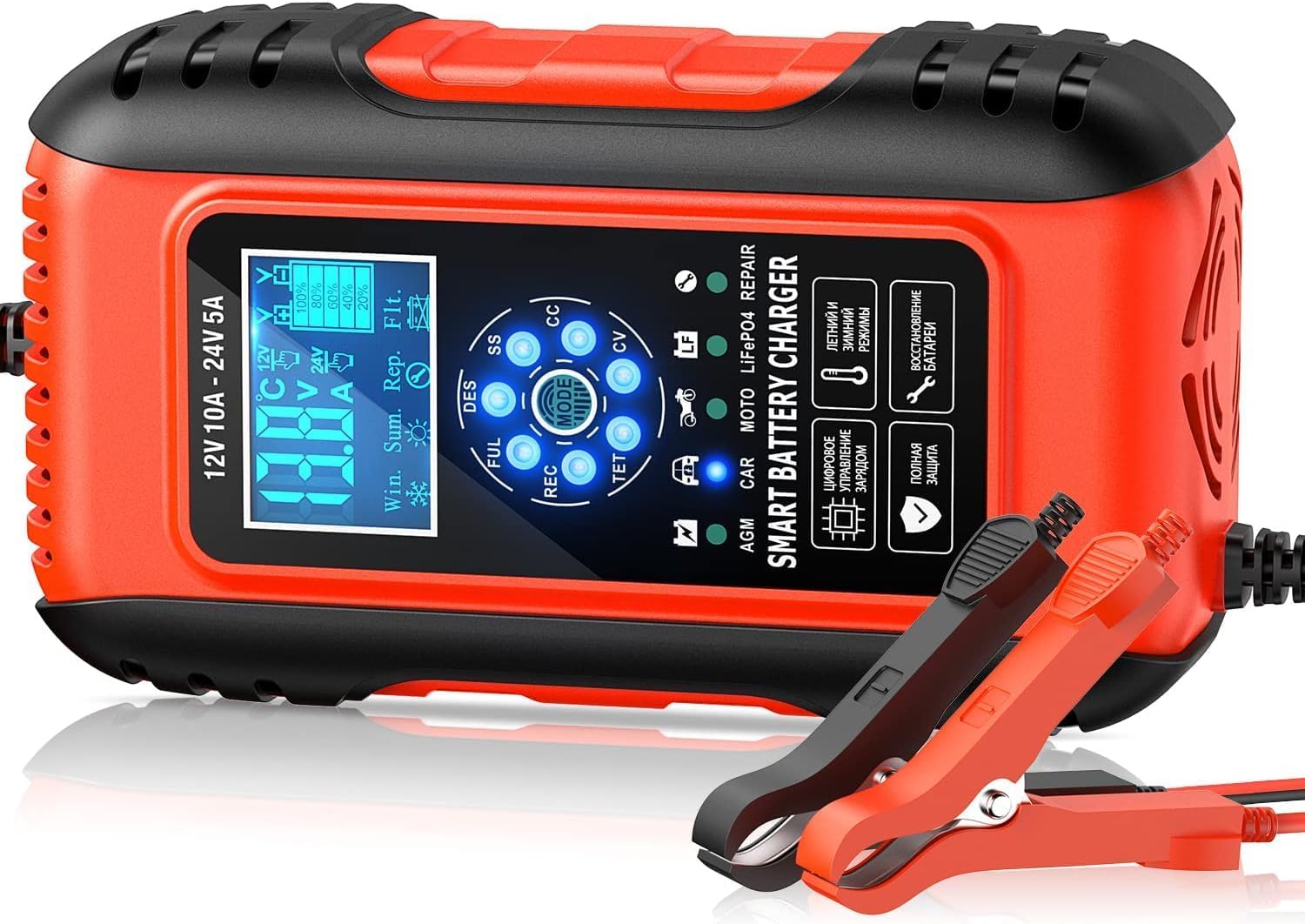
INTELLIGENT BATTERY CHARGER 10A – 12V / 24V LCD MULTI-PROTECTION
Automatic and intelligent 10A battery charger for AGM, GEL, Lithium, and Lead-Acid batteries. Compatible with cars, motorcycles, and boats, it offers 12V/24V charging, an LCD display, and protection against overcharging and reverse polarity.
🛒 Buy now on Amazon🔹 KYB (Kayaba) Excel-G – Value for Money
KYB's Excel-G are among the most popular aftermarket shock absorbers: we often see them as the first choice for Japanese SUVs and many platforms also shared by European brands.
Key Features
- Damping very closely replicating OEM values, with a slight tendency towards more control.
- Good build quality, with a very wide range of part numbers.
- Generally more accessible price than premium options.
Who they are ideal for
- those who want to restore original behavior while spending reasonably;
- those with an SUV that is not particularly heavy or used in extreme conditions;
- corporate fleets and light commercial vehicles.
Pros and Cons
- Pros: excellent value for money, wide availability, proven reliability.
- Cons: less "precise" than Bilsteins in demanding driving; not a sporty upgrade, but a good equivalent.
🔹 Sachs Super Touring – Balance for European SUVs
The Sachs Super Touring are often the natural choice for German, French, and Italian SUVs when a behavior very similar to the original is desired.
Key Features
- Balanced damping between comfort and stability.
- Strong presence as original equipment (OEM) on many European vehicles.
- Good durability, especially with tires and suspension in good order.
Who they are ideal for
- those who want to stick close to the manufacturer's original specifications;
- those who use their SUV primarily on asphalt and for normal loads;
- those seeking German quality without the price tag of more sporty kits.
Pros and Cons
- Pros: predictable behavior, perfect compatibility with most European SUVs, good durability.
- Cons: less "aggressive" than Bilsteins in cornering; those seeking a very rigid setup might desire something firmer.
💰 Average Costs, Workshop Time, and What's Included
Actual prices depend on the brand, SUV model, and region, but we can give approximate ranges for a single pair of shock absorbers (front or rear), excluding labor:
| Brand | Average Price (pair) | Estimated Lifespan | Replacement Time* |
|---|---|---|---|
| Bilstein B6/B8 | €300–€450 | 80,000–100,000 km | 2–4 hours |
| Monroe OESpectrum | €180–€280 | 60,000–80,000 km | 2–4 hours |
| KYB Excel-G | €150–€250 | 60,000–80,000 km | 2–4 hours |
| Sachs Super Touring | €200–€300 | 70,000–90,000 km | 2–4 hours |
*Indicative times for replacing a pair (front or rear) on a mid-range SUV, excluding any suspension alignment/toe adjustment.
What Can Be Added to the Quote
- dust boots and bump stops (recommended to replace them along with the shock absorbers);
- upper mounts / strut bearings if noisy or worn;
- wheel alignment after the work, especially if the front end is involved;
- any single-use bolts and fasteners specified by the manufacturer.
🔧 Practical Tips from the Workshop
- Always replace in pairs: never just one shock absorber per side, to avoid creating dangerous imbalances.
- Check springs and control arms: if the spring is weak or the silent-block is cracked, the new shock absorber won't work properly.
- Don't wait for them to "leak oil": when you see the leak, you're already past the performance decline phase.
- Trust your driving sensations: if the ESP intervenes much more often than before or you feel like you're "floating" on the highway, it's time for a check.
- For 4x4 SUVs used for light off-roading, consider slightly firmer products (Bilstein / some KYB versions) to better handle impacts.
❓ Frequently Asked Questions about SUV Shock Absorbers
How often should SUV shock absorbers be changed?
On average, between 70,000 and 100,000 km, but on heavy SUVs or those used on damaged roads, it may be prudent to check them at 60,000 km. More than mileage, symptoms matter: oscillations, noises, and irregular tire wear.
Can I change only the front or rear pair?
Yes, but always in pairs on the same axle. For example, if the front is worn out and the rear is still good, you can change only the front ones. Never replace only one shock absorber per side.
Is wheel alignment necessary after replacement?
Highly recommended for front shock absorbers, because components affecting geometry and alignment are involved. It's an additional cost, but it saves you a set of tires.
Is Bilstein always the best choice?
It is one of the top choices for control and durability, but it's not "the best overall." If you aim for maximum comfort and have a specific budget, a well-chosen Monroe, KYB, or Sachs might be more consistent with your actual use.
Can I install stiffer shock absorbers without changing the springs?
In many cases, yes (such as upgrading from a basic shock absorber to a Bilstein B6), but if you're looking for a truly sporty setup, it's advisable to consider a complete spring+shock absorber kit to avoid overstressing the original components.
📌 Conclusions and final advice
There isn't one "best SUV shock absorber" that suits everyone. There is a product that is most consistent with your use, your budget, and the type of vehicle you drive.
- If you want more control, less body roll, and greater precision, Bilstein B6/B8 is often the best choice.
- If you are mainly looking for comfort and absorption, Monroe OESpectrum will make you feel the difference on rough roads.
- If you want honest quality at a fair price, KYB Excel-G is a classic.
- If you have a European SUV and want to stay close to the original setup, Sachs Super Touring is the most straightforward path.
The real saving isn't "spending as little as possible on the part," but installing the right replacement part the first time, with a proper installation and a complete suspension check. This way, you'll enjoy your SUV for tens of thousands of kilometers more, with more comfort, more safety, and fewer surprises from the tire shop.
You might also be interested in:


